
White House pushes to dismantle climate research center
Clip: 12/26/2025 | 7m 44sVideo has Closed Captions
White House pushes to dismantle leading climate and weather research center
The Trump administration says it plans to dismantle the National Center for Atmospheric Research in Colorado, which is the nation’s premier atmospheric science center. The center was founded in 1960 and has facilitated generations of breakthroughs in climate and weather science. William Brangham discussed the move with climate scientist Kim Cobb and meteorologist Matthew Cappucci.
Problems playing video? | Closed Captioning Feedback
Problems playing video? | Closed Captioning Feedback
Major corporate funding for the PBS News Hour is provided by BDO, BNSF, Consumer Cellular, American Cruise Lines, and Raymond James. Funding for the PBS NewsHour Weekend is provided by...
White House pushes to dismantle climate research center
Clip: 12/26/2025 | 7m 44sVideo has Closed Captions
The Trump administration says it plans to dismantle the National Center for Atmospheric Research in Colorado, which is the nation’s premier atmospheric science center. The center was founded in 1960 and has facilitated generations of breakthroughs in climate and weather science. William Brangham discussed the move with climate scientist Kim Cobb and meteorologist Matthew Cappucci.
Problems playing video? | Closed Captioning Feedback
How to Watch PBS News Hour
PBS News Hour is available to stream on pbs.org and the free PBS App, available on iPhone, Apple TV, Android TV, Android smartphones, Amazon Fire TV, Amazon Fire Tablet, Roku, Samsung Smart TV, and Vizio.
Providing Support for PBS.org
Learn Moreabout PBS online sponsorshipWILLIAM BRANGHAM: The Trump administration says# it plans to dismantle the National Center for## Atmospheric Research in Colorado, which is the# nation's premier atmospheric science center.
In announcing the closing, Budget# Director Russell Vought called## the center -- quote -- "one of the largest# sources of climate alarmism in the country."
NCAR, as the center is known, was# founded in 1960 and has facilitated## generations of breakthroughs in climate# and weather science.
The announcement## has drawn outcry from meteorologists and# climate scientists across the country.
Earlier this week, I spoke with two of them# who are very familiar with the center's work.## Brown University's Kim Cobb is a climate# scientist and director of the Institute at## Brown for Environment and Society, and Matthew# Cappucci is senior meteorologist at MyRadar.
Thank you both so much for being here.
Kim Cobb, to you first.
What is NCAR and why,## as a climate scientist, is it so important# and seemingly precious to this community?
KIM COBB, Brown University:# Thanks for having me, William.
NCAR is a really historic# institution in our field.
It,## of course, dates back decades now.
And, over# that time, it has really woven itself into the## fabric of both weather and climate science# across the country and around the world.
We're talking about unique, one-of-a-kind# facilities like supercomputers, ticked-out## airplanes, and most importantly, a staff of over# 800 people who are at the top of their game in## innovating in weather and climate science for# public good, putting out data that is on every## single climate scientist's computer around the# country, if not around the world, and a nexus of## collaboration as well that is important training# grounds for the next generation of leaders.
WILLIAM BRANGHAM: And, Matthew# Cappucci, as a meteorologist,## how important is NCAR to your profession?
MATTHEW CAPPUCCI, Senior Meteorologist,# MyRadar: I mean, NCAR is really the## birthplace of all the tools# we use, both technologically.
And, really, the discoveries that are made# at NCAR are crucial to our understanding## of how the atmosphere works.
That's# where we first learned about the MJO,## the Madden-Julian Oscillation, one of# the biggest overturning circulations in## the atmosphere that governs how so many# things, for example, hurricanes behave.
It's where we first created a special product# used by airplanes when they're landing to avoid## wind shear, disruptive changing winds with# height that could cause plane crashes.
They## invented a system there to prevent that.# That's where dropsondes were invented,## those little probes that are dropped# out of the belly of airplanes in the## middle of hurricanes to figure# out how strong the hurricanes are.
So, so many different tools and# discoveries have come from NCAR.## In addition, the modeling is incredibly# important.
And if we're sort of putting## the brakes on that, I worry about the# implications for weather forecasting.
WILLIAM BRANGHAM: Kim Cobb, well, what more on# that?
Well, let's say NCAR is broken up.
What## are the impacts, both for the scientific community# and for Americans who benefit from its research?
KIM COBB: I think what's really important# to remember is that NCAR focuses on the## entire continuum from weather that ranges# over hours and days that's designed to## aid the forecasts that keep people safe# and protect infrastructure and our economy.
But they also go all the way out# to looking decades into the future## and really understanding that most# important intersection right now,## how weather is responding to ongoing# climate change.
It's these kinds of## questions at the very forefront of our# field that they're focused on right now.
And these are innovations that are going to reap# absolutely untold dividends through time.
So, by## breaking this -- these up and its component parts,# if you will, first of all, the administration has## made clear that it's the climate portion of the# portfolio which they are taking squarely in aim.
And, of course, that is the portion that# is right now so important to invest in## as we seek to understand more about the coming# threats and impacts of ongoing climate change,## 2025, of course, wrapping up to be# tied for the second warmest year ever.
WILLIAM BRANGHAM: And, Matthew, the White House# has argued that NCAR and its undertakings and## its work is somehow contaminated with# woke ideology or climate alarmism.
Is there research or data that is coming out## of NCAR that is politicized# or ideological in any way?
MATTHEW CAPPUCCI: Truth be told, no.# The atmosphere does not possess a voter## registration card.
I think it's important# to remember that scientists do science.
And,## really, the only people doing the# politicization are, for the most part,## politicians and the general public and the media.
It worries me, though, that this fits into# an overall pattern of the demonization of## both science and academia.
The idea that# we're trying to shut down science that## produces results we don't like, it's# a very worrisome trend.
And we have## seen this other times in history,# and it never really ended well.
And I'm just very concerned about the tone that's# being taken that simply because one political## party or even one political person doesn't like# the fact that we're learning about the atmosphere.
WILLIAM BRANGHAM: I mean,# Kim, as Matthew is saying,## we know that President Trump has called climate# change a hoax.
He believes it's nothing that## we need to focus on.
He has directed so# much of the administration to move away## from climate research, from renewable# energy, doubling down on fossil fuels.
I'm just curious as to what -- are you# worried similarly about the future of## climate research if we continue to chip# away at these foundational projects?
KIM COBB: Well, obviously, as Matthew said, we# turn our backs on science to great risk and peril.
And I think most Americans get it right now.# In the headlines every year are these horrific## climate-fueled disasters that have taken such# a toll on communities and our national economy,## to the tune of billions of dollars per year.# So this is not a controversial subject in that## regard.
People do want the best available# science information to protect themselves.
And that's exactly what NCAR and its# scientists are focused on.
And I think the## Trump administration is just not understanding# how long an investment has been made to get us## to this point and the many dividends that we# have already reached and that, once you break## something like this, it's really going to be hard# to put it back together again.
That's my concern.
WILLIAM BRANGHAM: Matthew, the OMB# director in his announcement said## they will do a systematic review of the# work that NCAR does, and critical weather## information and research will just get sent# somewhere else or done in another location.
How confident are you that a breakup of NCAR could# still keep some of the critical elements intact?
MATTHEW CAPPUCCI: I think so many times# this administration has historically put## the cart before the horse.
And what I mean# by that is, it seems like just a year ago,## they were cutting a huge chunk of# National Weather Service forecasters.
And then, after they were laid off, the government# realized, oh, wait, we kind of need them, and## brought them back.
This seems like another really# shortsighted decision made by the administration## without realizing or fully researching the# potential implications of what could happen.
And I also just sort of think this strikes the# wrong tone for just about everybody.
Weather## and climate affect everybody.
And, realistically,# you're much more likely to be hit by a tornado or## hurricane in a red state.
And so I'm surprised# by sort of Trump and his administration doing## something that could potentially have negative# impacts on his own core audience and following.
WILLIAM BRANGHAM: All right, that# is Matthew Cappucci and Kim Cobb.
Thank you both so much for being# here.
We really appreciate it.
Breaking down U.S. strikes and the conflict in Nigeria
Video has Closed Captions
Clip: 12/26/2025 | 10m 25s | Breaking down U.S. strikes on ISIS in Nigeria and the complicated conflict there (10m 25s)
British panto blends holiday tradition with Muslim culture
Video has Closed Captions
Clip: 12/26/2025 | 3m 48s | British panto production blends holiday tradition with Muslim culture and humor (3m 48s)
Brooks and Atkins Stohr on Trump's return and its impact
Video has Closed Captions
Clip: 12/26/2025 | 11m 32s | Brooks and Atkins Stohr on Trump's return and its impact on the country (11m 32s)

Film critics name their picks for the year’s best
Video has Closed Captions
Clip: 12/26/2025 | 8m 48s | Film critics look back at 2025 and name their picks for the year’s best (8m 48s)
Imran Ahmed on Trump's threat to deport him over censorship
Video has Closed Captions
Clip: 12/26/2025 | 6m 30s | Imran Ahmed on Trump's threat to deport him over 'censorship' for countering online hate (6m 30s)
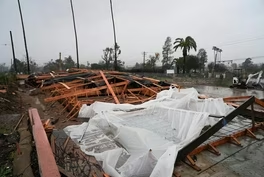
News Wrap: Southern California faces more relentless rain
Video has Closed Captions
Clip: 12/26/2025 | 3m 44s | News Wrap: Relentless rain adds to California's wettest holiday season in decades (3m 44s)
Providing Support for PBS.org
Learn Moreabout PBS online sponsorship
- News and Public Affairs

FRONTLINE is investigative journalism that questions, explains and changes our world.

- News and Public Affairs

Today's top journalists discuss Washington's current political events and public affairs.









WHYY Series
Support for PBS provided by:
Major corporate funding for the PBS News Hour is provided by BDO, BNSF, Consumer Cellular, American Cruise Lines, and Raymond James. Funding for the PBS NewsHour Weekend is provided by...