Docs on Call
Fighting Pediatric Cancer
9/2/2026 | 26m 24sVideo has Closed Captions
Doctors examine advances improving survival and care for children with cancer.
Dr. Kay Saving and Dr. Brinda Mehta of OSF HealthCare Children’s Hospital of Illinois discuss four decades of progress in pediatric cancer care. They explore rising survival rates, immunotherapy, targeted treatments, clinical research and the comprehensive support helping children and their families through diagnosis, treatment and survivorship.
Problems playing video? | Closed Captioning Feedback
Problems playing video? | Closed Captioning Feedback
Docs on Call is a local public television program presented by WTVP
Docs on Call
Fighting Pediatric Cancer
9/2/2026 | 26m 24sVideo has Closed Captions
Dr. Kay Saving and Dr. Brinda Mehta of OSF HealthCare Children’s Hospital of Illinois discuss four decades of progress in pediatric cancer care. They explore rising survival rates, immunotherapy, targeted treatments, clinical research and the comprehensive support helping children and their families through diagnosis, treatment and survivorship.
Problems playing video? | Closed Captioning Feedback
Where to Watch Docs on Call
Docs on Call is available to stream on pbs.org and the PBS app.
Providing Support for PBS.org
Learn Moreabout PBS online sponsorship- Despite more children being diagnosed with cancer today compared to 40 years ago, the risk of dying from childhood cancer has dropped tremendously.
Tonight, we focus on cancer care options here in central Illinois.
(inspiring music) (inspiring music continues) Good evening, and thanks for joining us for WTVP's "Docs on Call."
I'm Mark Welp.
For more than 40 years, the hematology-oncology team at OSF HealthCare Children's Hospital of Illinois has cared for patients in and around central Illinois.
It's safe to say a lot has changed since the 1980s.
Dr.
Kay Saving is the director of medical services for OSF HealthCare Children's Hospital of Illinois, and Dr.
Brinda Mehta is the director of the Cancer and Blood Disorder Institute at OSF Children's Hospital of Illinois.
Doctors, thanks for coming in.
We appreciate it.
- Sure.
- Thank you.
- We've got a lot of experience here today between the two of you, and I want to say congratulations on 40 years at OSF.
That is amazing.
- That's a long time.
- Not only to be at one employer, but to be in this field.
- Correct.
- How have things changed over the 40 years?
And I assume they're all for the better, or most of it.
- Yes.
Well, lots of changes.
So, for instance, back in the '60s, '70s, the survival overall for kids with cancer was about 60, 65%.
Now it's about 85, 90%.
We still have trouble treating some cancers.
Not every child diagnosed survives, but most of them do, which is a great thing.
And that's because lots of things have changed.
At the beginning, when we first had kids diagnosed with cancer, we sort of said, "We've got to..." And the cure rate was very low.
"...we've got to do things about that.
We've got to really maximize what we're doing, use new drugs, do things for children."
We started with drugs that were used in adults and then use those in children.
Things that have really helped are like combination chemotherapy.
So we rarely treat with just one drug, usually multiple drugs, both in adults and children to treat that.
Other things have come about, such as bone marrow transplant, which has been very helpful for children as well as adults, but children and teens with cancer.
As we got better at the cure rate, then we said, "Let's work on the best, least therapy because there are side effects to all the things that you do for treatment for cancer."
And so we wanted to kind of mold it so that we didn't have a lot of those late effects.
Now we still have some, and that's an area of research now, an area where people work in that area to help those kids do better with any late effects.
But that has really helped us lessen those late effects.
Now we have more individualized kind of therapy for certain cancers.
If there's a specific genetic mutation, then we can target that with different kinds of drugs for that.
There's immune therapy, so we can help use the patient's own immune system to fight off certain cancer cells, things like that.
And now, one of the newer things, gene therapy.
So all of those things have really helped us be able to have a better survival rate for kids with cancer, as well as try and lessen the late effects.
- We've seen the treatments change.
Have we seen the diagnosis change?
I mean, I don't know if there's anything you can do to see it coming, but how is that different than it was 40 years ago?
- Well, I think that now we have testing that we can do that really is more specific for a cancer.
So if someone has a certain kind, that has leukemia, for instance, now we know a lot of specifics about leukemia.
So there's testing you can do so that you can individualize that therapy and give certain children drugs that will help with the kind they have, the subset or subtype, and other kinds of treatment for other children that have different kinds of subtypes of leukemia.
- And, Dr.
Mehta, here in Peoria, you've been here a while, too, not 40 years, but you've been here a good amount of time.
Just in the amount of time you've been here at the children's hospital, I know there have been new therapies, more doctors coming on board.
What have you seen change?
- I think with the science advancing so nicely, immunotherapy is definitely a big thing we're seeing.
We're harnessing, or researchers have come up with really good medications where you harness the body's immune system to attack the cancer.
So that has really changed the landscape and the paradigm of the way to treat cancer, and also targeted treatments.
So you really, when the tumor is taken out, the pathologist and what we call next-gen sequencing, you can really tailor based on if there's a mutation found, then instead of just, like a buffet, just like giving any chemotherapy, we can actually tailor it to that mutation.
And so the child or the patient is getting more cancer-specific chemotherapy.
Those potentials and those options have advanced, and I think that's what makes it more promising for us.
It's like, okay, we have more options.
We can do something.
And so it's a very exciting time for oncologists because we feel like, okay, we can continue to do more.
- You've got a lot of good tools here.
I'm curious, 40 years ago, would you send a lot more kids to, say, Chicago or Illinois because we didn't necessarily have the technology here in Peoria and central Illinois?
- I think even 40 years ago we did a great job taking care of kids here.
Still, pediatric oncology is kind of a small club.
There aren't nearly as many diagnoses per year as there are on the adult side.
And so it's a smaller number of people that take care of the patients.
And so all of us have a network with experts across the United States that we know.
And so if a child comes in with something very unusual, something not seen very often or a very specialized kind of treatment, we know who to call.
And my partners who do much more oncology, I don't do that much, do more hematology, but they have their buddies that are places where they have the expertise for a very unusual tumor type to treat.
And so they'll call them, get advice; a patient may go there.
But we've always worked together very closely in that way so that we could pool our results and improve care overall.
- We mentioned, you know, the hematology-oncology team at OSF.
Let's talk about the difference between hematology and oncology.
- Okay.
Well, hematology is talking about blood disorders.
Oncology is cancer.
And so sometimes there's some overlap.
So like leukemias are a cancer of the blood, but they're generally cared for by the oncologist.
And so hematology are blood disorders, like anemia would be one, some sort of bleeding disorders.
My major clinical role now is being in charge of our sickle cell program.
So we have a sickle cell lifespan program where we take care of, from birth throughout the rest of life, patients with sickle cell disease, which is an inherited disease.
So a lot of the blood disorders that we take care of are inherited diseases.
That's fairly common in blood diseases.
- Now, can the hematology diseases like sickle cell, can those mutate into cancer, or vice versa?
Is there anything there together?
- No, there are some we call predisposition syndrome.
So there are some kinds of diseases that can be hematology diseases, so blood diseases that have a propensity or an increased risk of developing cancer, but that's the minority, way in the minority, and that's very specialized individual things.
So, in general, they are two separate things.
- Let's talk about research a little bit going on at OSF.
I know there's a lot of cancer research.
Can you tell us what's going on these days with that?
- Sure.
For peds, mainly in oncology, whether it's peds or adult, clinical trials research is the cornerstone, and that's what helps, you know, us advance significantly.
And so OSF and UICOMP's commitment to research is in the form of being partner or being a part of the North American Childhood Oncology Consortium called COG.
So we have several clinical trials for pediatric cancer patients for multiple disease conditions, so whether it's leukemia, lymphoma, Hodgkin's disease, neuroblastoma.
So whenever COG opens a trial, we vet it and see, okay, are we able to open this trial here?
And then we try and open.
So we have several trials open here for that.
And we also have a few trials open for like long-term effects.
So once they're done with cancer treatment, we have a few trials to monitor and detect any long-term effects.
So that's the, I'd say, a portfolio of clinical trials through Children's Oncology Group.
And then there are a few trials, you know, I wouldn't say trials, but research for quality improvement and some registry-based trials that as being part of UICOMP, we try to have some small investigator-initiated trials as well to give and improve cancer care and supportive care.
And I will have Dr.
Saving talk about some of the sickle cell stuff that they do.
- So sickle cell, that area is newer in clinical trials because there was not a lot of activity going on for a long time in research with sickle cell disease.
But the last 20, 30 years there's been much more.
And so there are clinical trials now.
Mostly they start in adults so that side effects of drugs and things can be looked at, and then they move them down to children.
And so we, being a smaller center here in our lifespan clinic, we have maybe a total of about 200 patients.
We haven't run a lot of clinical trials.
We've done a couple in the past in adults with sickle cell disease, and we're getting ready to open one this fall, which is a trial of a new oral therapy for sickle cell disease.
And so you take it every day, and it helps prevent the side effects and some of the problems with sickle cell disease.
So we're going to be actively doing that also.
- You mentioned lifespan clinic.
What exactly is that?
- So for sickle cell disease, for many, many years there have been a lot of pediatric hematologists, oncologists who have taken care of that disease.
And I'll say 50, 60 years ago in the United States, many of the people, most of them with sickle cell disease did not survive to adulthood.
We've had great advances, such as newborn screening, preventing infections with prophylactic antibiotics, immunizations, which are critical for children with sickle cell disease, and a new drug called hydroxyurea, which has been used the last 30 to 40 years in sickle cell disease, which really helps prevent a lot of the problems with that disease.
So now that we have that children are surviving into adulthood, though the average lifespan is only about 45 to 50, 20 years less than the rest of the American population.
But since the children are now living, we need to train more doctors to take care of adult sickle cell patients.
So they still have a lot of trouble finding care because there aren't that many adult hematologists that know much about sickle cell disease, because they haven't had to care for those patients for decades and decades.
So we have a med-peds trained physician who's also trained in pediatric hematology-oncology who joined us a couple years ago, Dr.
Light, and she sees adults in our lifespan clinic.
So the adults are seen in a clinic in one part of the campus, and then we see our kids in another part of the campus in the Hem-Onc clinic.
But we are caring for them across the whole lifespan.
So we get them close to the time of birth because of newborn screening.
The state alerts us to these children, and we get them started on that treatment.
And then we transition them to adult care, and that adolescent transition time is very important because adolescents are not always thinking quite right about what to do and take my meds and do the right things.
So we do a lot of training of them so when they get on the adult side, which is very different from the ped side, then they'll be able to speak for themselves and get good therapy.
- Well, it seems like it would be more beneficial because, you know, if someone gets sick, say, as an infant, they may go to a pediatrician, then as they get older, okay, go to this doctor over here, doctor over here.
- Correct.
A lot to manage.
It's a lot to manage.
And as an adult, the expectation by the medical services are you're going to be able to make your appointments and manage your care.
And it can be very complicated.
And if your mom did it your whole life and now you're over there, that's hard.
So we spend several years helping them learn that.
- Dr.
Mehta, what makes a good candidate for clinical research, especially when it comes to a child?
- It depends on the disease.
So rather than the child, we have to look at what diagnosis a particular child has, and then we look to see if there's a matching clinical trial.
And whether it's a new diagnosis, a child walks in and they have a new cancer, then they may have more clinical trial options.
And sometimes when the cancer comes back second time, third time, then we have to look at what other options are available.
So I would say it's more dependent on the portfolio available through the research consortium, not really child-dependent.
And then we have certain, you know, very black-and-white parameters.
Like to do research, there are, or to enroll a child in a trial, they're very black-and-white parameters: what age group they are, and do they have certain preexisting conditions or not.
So that's where it's more behind the scenes, where the clinical research nurses look at those eligibility criteria.
So those are things we sort of do behind the scenes to enroll a child or a, you know, patient with an oncology condition.
- And I know you both have explained the relationship between yourselves, Children's Hospital of Illinois, and the University of Illinois College of Medicine Peoria.
How does that work?
- You want to do that or you want me to do that?
- Yeah, absolutely.
So OSF and UICOMP have a very integrative, interconnected clinical and sort of research partnership.
So UICOMP is like the regional medical school, and then OSF is the major regional medical center.
So that's where there's an academic and clinical partnership.
Especially in pediatrics, we have most of our faculty members, the physicians, residents, subspecialists.
We're all faculty members of University of Illinois College of Medicine Peoria, but Children's Hospital is the major teaching hospital, and that's where we function.
So we are all hired, housed, trained.
A lot of the residents, medical students are trained through UICOMP, and then we work at Children's Hospital of Illinois.
So there's very close integration, clinical-academic partnership.
You may have heard of residency programs, fellowship programs.
So those are all UICOMP, but then the hands-on day-to-day training and all that is done at Children's Hospital.
And this is common setup across the country where there's a strong academic and a, you know, community hospital partnership.
So that's what we have over here.
And I think it works, you know, really well.
Anything else you'd like to... - No, and I mean, really, one can't exist without the other.
If you want to have a strong children's hospital, you have to have very competent, very complete care from the hospital, which is what OSF and Children's Hospital provides.
And you've got to have the physician expertise.
And generally, as Dr.
Mehta said, those people are usually hired by a university because they want to do research and they want to teach, be involved with residents.
So it works out really, really well in Peoria that it's just a really good match.
And the Department of Peds is the department within the medical school that really has that strongest link together.
- Over your 40 years, have you kept up with students who you've maybe mentored as they take their skills now and maybe move around the country and do this kind of work?
- Yeah.
And I have, and I've had some students that I taught years ago that did some research projects with me and other things that then went off and did some residency and did some fellowships.
And now a couple have come back here, and they said, "We want to come back here.
We'd like the setup here with CHOI and the university."
And so I see them and am doing some projects with them.
So it's, yes, it's very rewarding to see people as they advance through their career.
It's quite interesting.
- I bet.
Dr.
Mehta, tell us a little bit about, besides diagnosing and treating cancer, expand that a little bit to talk about the families of these kids who are fighting cancer, and not just the medical treatment that you provide, but also emotional help and things like that.
- Yeah.
So, yeah, cancer initially, just, you know, the diagnosis, but what follows off that needs an entire village to take care of the child, the family.
So we have at Children's Hospital a very robust psychosocial team through the Heller Center.
And then the children's hospital itself, you know, from sedation services, specialized programs, the survivorship program, adolescent, young adult program.
Again, back to the Heller Center: counseling, an exercise physiologist, social worker, child life.
There's a music therapist.
So as Children's Hospital has grown, and as we know, as we've realized that it's not enough just to give, like you point out, not just medications and chemo or radiation, the effects and every single day, there's so many aspects that we need to take care of that we have over the years.
And Dr.
Saving has helped with a lot of that building, building that village that can support each child and family.
So that's what we have.
We have lots of people, both inpatient, outpatient, medical insurance.
I always tell people American healthcare system is very good.
I think it's really good, but we still have to go around the insurance.
So having case managers, which sometimes we don't talk about, but case managers, they spend so much time, you know, working on getting medications and approval.
So behind the scenes, the doctors, nurses, you see them at the front, but behind us there's an entire hardworking support group that touches every aspect of care, from medication ordering, to getting it approved, to the pharmacist.
Like, you know, we cannot function and provide the care without them.
- Yeah, that's dealing with insurance companies, you know, is no fun, especially for families who have a lot more to worry about than paperwork.
And I want to ask this for both of you: In your opinions, besides the treatments and all the high-tech stuff, how much do emotions and state of mind play in this, not only for the patient, but for the family, trying to keep spirits up, keeping hope alive?
How important is that?
- Well, I think it's critical.
And I think that a child's diagnosed with cancer, and so a lot of the energy is initially put on the diagnosis, as it should be, and getting the firm diagnosis and explaining that to the family and what's the medical treatment going to be, because that's the most important thing at the beginning.
But as we know, as Dr.
Mehta said, there need to be a lot of extra supports during the journey through cancer treatment, both for the child and for the family and for the time beyond.
And so as Dr.
Mehta mentioned, the Heller Center, John Heller 10 years ago now made a very generous contribution.
We've built upon that, and that turned into the Heller Center for Kids with Cancer.
So it has all these support personnel.
It's really basically mainly paying for support personnel, and Dr.
Mehta mentioned a number of them.
And one really important component are counseling.
So we have embedded counselors that are actually in the clinic, and they work with the child and the family and the siblings, the grandparents.
This is a family disease.
A child gets cancer, it's a family disease.
And so we need to have that support.
And that support isn't just at the time of diagnosis, but it's through the whole treatment and beyond when Dr.
Mehta has her after completion of treatment clinics, then all of our Heller support people come to those clinics and help support the families.
The other thing that's really important is as you're going through that battle against the cancer, going through that journey, it's really a good thing to be able to try and establish some normalcy.
If this is a school-aged child, they should be going to school or at least doing their studies, because likely they'll be cured of their cancer and then they want to have a life where they're doing what they wanted to do, have their dream job, et cetera.
So we have like an educational coordinator in the clinic that's very, very helpful working with schools, helping with job thoughts, helping with college applications, scholarships, all those kinds of things.
The dietician that helps get the best nutrition, the exercise physiologist so that you're doing those things so that while you're being treated for cancer, you are remaining as strong as you can possibly be.
And then once you're done with the treatment, you get the follow-up through Dr.
Mehta's clinic, but these other caregivers also help you follow up.
And a newer addition is probably our navigator, a navigator devoted to helping the family navigate at the beginning, because when you're first diagnosed, it's really difficult to know how to access all those things, insurance and others.
But this navigator sort of takes them by the hand and says, "Here's kind of how we're going to go through it, along with the counselors and the medical team."
So it sort of cocoons the family and helps them get that extra support that they need.
- Yeah, that definitely helps for sure.
And how important is it for the caregivers to have a smile on their face and be optimistic?
I know it can't be easy all the time.
- I think for parents, too, you have to maintain that face in front so the child is content and happy.
So I think the parents have to bear a lot, go through a lot.
And so I think having the nurse navigator to help them walk through after I deliver the diagnosis and I walk away, that's when nurse navigators, counselors, they really step in and help the family and say, you know, "Don't worry, we're here.
You have any questions, problems, please feel free."
Social workers.
So these team members really try, and their goal and intent is to keep the siblings, the parents, you know, as well informed as possible.
Having to help with the mental health thing, too, a lot of our families, as you know, might travel from 30, 40 minutes, two hours away.
Having services close by like Ronald McDonald House, Family House, that all helps also to alleviate some of that day-to-day discomfort and just have a place to go, a quiet place to go.
So I think it's so much more that's available in central Illinois in this area to help our patients and families in these tough times, during these tough times.
- We really are lucky, because it seems like the bigger cities get this kind of world-class treatment, but for a smaller area like central Illinois, it's pretty amazing that we have all this.
Tell us, we just have a minute before we have to go, but let's talk about the future.
What do you see on the horizon maybe as far as treatments or things like that that you're excited about?
- Absolutely.
Yes, future I'm excited for the ever-growing new medications and immunotherapy and sort of being able to tailor the treatment to the patient's individual diagnoses.
And then the concept of pharmacogenomics, and OSF, along in the electronic medical record, is trying to incorporate what we call pharmacogenomics.
So not just what chemotherapy, but how are other medications, how do we metabolize each drug?
So trying to incorporate the genomics of each person or each cancer patient so that they can better handle these therapies.
So I think that's exciting, and it's a commitment at the higher level.
And so those are exciting things, and ever-growing psychosocial support, like the newest addition, the newest navigator.
So I think those are the things we're looking forward to and would like to continue expanding.
- Great stuff.
Well, we appreciate the information from both of you.
Congratulations on your 40 years.
Real quick, what's the secret to lasting 40 years with the same employer and the same business?
- Liking what you do and having a great team.
We have everyone who works with our patients and in our clinic, they are committed to the absolute best care of the patient and the family.
There's no question about that.
And so if those are the people that you work with, it's easy to come in every day and work, and it's enjoyable because you're all trying to do the same thing.
- Same thing.
- All right.
Well, we appreciate your time today: Dr.
Kay Saving and Dr.
Brinda Mehta with the Children's Hospital of Illinois.
Great information.
Thank you very much.
- Thank you.
- Thank you for having us.
- Sure.
And thank you for joining us.
You can watch this show again and share it at wtvp.org.
You can find out about future show topics on our Facebook and Instagram pages.
And, of course, we always want to know your questions and topic suggestions.
Message me on social media or leave a comment.
Thanks for watching, and take care of yourself and your family.
(inspiring music) (inspiring music continues) (bright music)
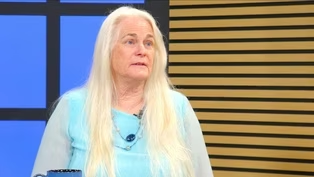 New
NewHow Childhood Cancer Treatment Has Changed
Video has Closed Captions
How childhood cancer survival rates have improved through advances in treatment. (2m 2s)
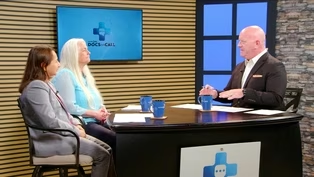 New
NewA New Era of Personalized Cancer Treatment
Video has Closed Captions
How immunotherapy and targeted treatments are transforming pediatric cancer care. (1m 6s)
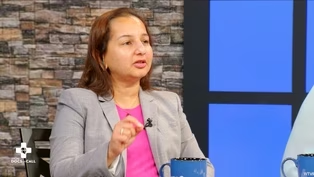 New
NewSupporting the Whole Family Through Childhood Cancer
Video has Closed Captions
Why treating childhood cancer requires support for the entire child and family. (1m 7s)
Providing Support for PBS.org
Learn Moreabout PBS online sponsorship

- Science and Nature

Explore scientific discoveries on television's most acclaimed science documentary series.
 New Episode










Support for PBS provided by:
Docs on Call is a local public television program presented by WTVP