
July 2, 2026
7/2/2026 | 55m 28sVideo has Closed Captions
Rose Gottemoeller; Ami Ayalon; Dahlia Scheindlin; Jason Stanley
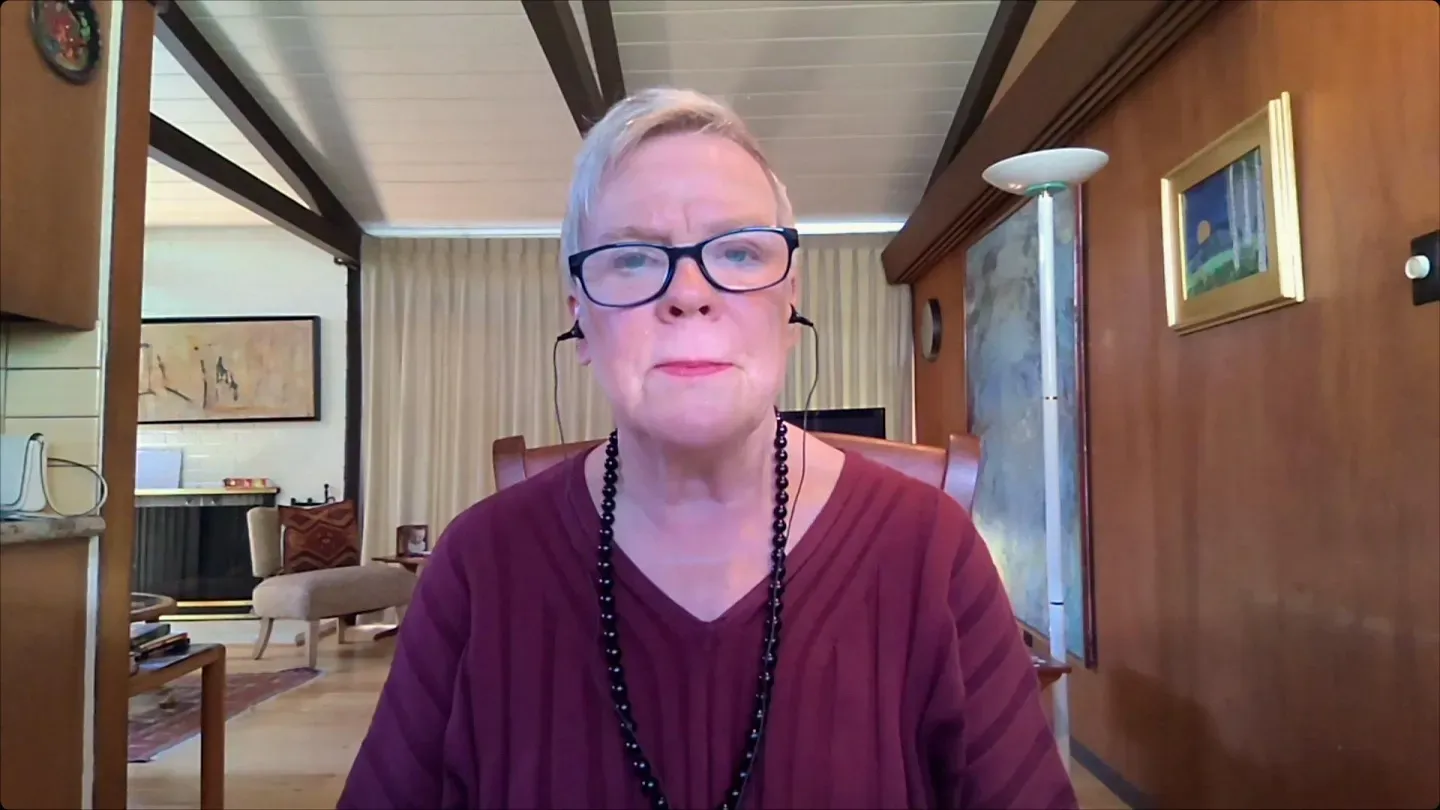
Fmr. NATO Deputy Secretary-General Rose Gottemoeller discusses Russia and Ukraine's attacks on each other. Fmr. Israeli security official Ami Ayalon marks 1,000 days of war between Israel and Hamas. Israeli political analyst Dahlia Scheindlin discusses how this is weighing on Tel Aviv's global relations. Prof. Jason Stanley discusses Pres. Trump's immigration agenda.
Problems playing video? | Closed Captioning Feedback
Problems playing video? | Closed Captioning Feedback
July 2, 2026
7/2/2026 | 55m 28sVideo has Closed Captions
Fmr. NATO Deputy Secretary-General Rose Gottemoeller discusses Russia and Ukraine's attacks on each other. Fmr. Israeli security official Ami Ayalon marks 1,000 days of war between Israel and Hamas. Israeli political analyst Dahlia Scheindlin discusses how this is weighing on Tel Aviv's global relations. Prof. Jason Stanley discusses Pres. Trump's immigration agenda.
Problems playing video? | Closed Captioning Feedback
Where to Watch Amanpour and Company
Amanpour and Company is available to stream on pbs.org and the PBS app.
Watch Amanpour and Company on PBS
PBS and WNET, in collaboration with CNN, launched Amanpour and Company in September 2018. The series features wide-ranging, in-depth conversations with global thought leaders and cultural influencers on issues impacting the world each day, from politics, business, technology and arts, to science and sports.Providing Support for PBS.org
Learn Moreabout PBS online sponsorship>> Hello, everyone, and welcome to "Amanpour & Co."
Here's what's coming up.
[ Gunfire ] Putin lashes out with a massive missile attack on Kiev, killing civilians as well.
I asked the former NATO deputy secretary general how the alliance will face an increasingly unpredictable Russian president.
Are their militaries ready?
Then, after 1,000 days of war since October 7th, Prime Minister Netanyahu touts a permanent state of conflict for Israel.
At what cost?
And how are Israelis responding?
I asked political analyst Dalia Shainlin and the former head of Israel's security service, Ami Ayalon.
This is going to be ethnic cleansing that will be a stain on the soul of America for as long as this nation exists.
What could Trump's immigration policy become?
Toronto University Professor Jason Stanley tells Michel Martin he has grave fears for America's future.
Amanpour & Co.
is made possible by the committed to bridging cultural differences in our communities, by contributions to your PBS station from viewers like you.
Thank you.
Welcome to the program, everyone.
I'm Christiane Amanpour in London.
Search and rescue operations are underway in Kiev after the Ukrainian capital was blitzed by Moscow overnight.
Russia bombarded the city with more than 70 missiles and hundreds of drones, Ukraine says.
Most were intercepted, but some got through, killing more than 20 people and injuring dozens more and sending thousands of people fleeing into the subway stations for shelter.
According to Kiev, most of the Russian strikes hit ordinary residential buildings.
This after Putin has absorbed weeks of increasingly effective Ukrainian attacks deep inside Russia, targeting Moscow and Crimea.
And today, inspecting some of the devastation in Kiev, President Volodymyr Zelensky said the U.S.
and Ukraine have resumed talks to end the war, but he called on President Trump's envoys to finally come and see for themselves.
>> They have to come to see, to understand, and to explain to the president, and then to answer in a very polite manner how Steve Vitkoff can to Russia what they have to do.
Quickly sit, negotiate, stop this war.
Zelensky says he plans to talk to Trump at the NATO summit in Turkey next week.
Joining me now is Rose Godemuller, former NATO Deputy Secretary General, and in her latest article for Foreign Affairs, she explores how Russia's war in Ukraine could signal, quote, "the strange defeat of nuclear deterrence."
Rose Godemuller, welcome back to the program.
Can I start by asking you what you think is going through Putin's mind as he goes really very full on in a terrible offensive overnight, as we explained, after Ukraine is having more and more success targeting Russia.
What do you think is happening?
This missile duel has been going on for some time, but it is definitely ratcheting up, just as you pointed out, with very severe attacks on civilian targets, which is horrific.
The Russians don't seem to care about civilian targets.
I will say the Ukrainians, in their return strikes, do tend to focus on military targets and industrial targets, the oil industry in Russia particularly.
But it is a missile duel that is ratcheting up steadily, and I think part of it is Putin is frustrated, he doesn't know what to do next as the Ukrainians continue to blast away at Russian targets, and so he's trying to up the game by attacking Kiev in this incredible wave of missiles and drones, not only last night but in recent weeks.
Can I just clarify, it's not really a missile duel, is it?
I mean, Ukraine doesn't have ballistic missiles, does it?
It does have some very capable missiles, cruise missiles, air-breathing missiles, and also some ballistic missiles.
Don't forget that the Ukrainians are great missileers.
They were building Soviet ICBMs back during the Cold War era, and so they know this technology very, very well.
But where they have made their mark is in developing all of these shorter-range and cheap drones that are really smothering, I think, a lot of Russian defenses in this recent period.
>> So, how would you analyze, beyond what you've just said about Putin -- you know, he has been studiously publicly unaffected by the massive toll that it's having on Russia, the massive casualty toll of dead and wounded, the financial toll given the sanctions, and now with the price of gasoline at home, and they're, you know, restricting it in some parts like Siberia, and he went on state television just a few days ago, and he said, "Obviously, this is creating problems about the strikes on oil targets, et cetera."
He plays it all the time, saying it's not critical.
What do you make of his public appearances recently and what he's saying?
-He's begun to hint that he wants to see an end to this war.
Speaking publicly this week, just as you said, it was the first time that he acknowledged there was a bit of a problem from the Ukrainian missiles and drones falling on Russian territory.
And he's begun to indicate by saying that Zelensky has suggested it, that they should somehow cease exchanging missiles in this duel that I spoke about a moment ago, and take that as a kind of first step in some kind of negotiated process.
So I begin to think that Putin is looking for a way out of this war, although he hasn't given up on articulating his maximalist demands that all of the Donbass be given up, etc.
So there has been, I would say, no change in his overarching demands, but at the same time underneath a kind of quiet, I would say, new interest in perhaps some negotiation process.
How do you think there can and will be able to be some change in his maximalist demands?
Because even President Trump, who up until now has essentially basically said and indicated in many ways that he believes Putin has the upper hand and, therefore, the sooner we give Putin what he wants, the better.
But now he's beginning to say that, actually, Ukraine looks like they're being certainly very courageous, he said.
They've got great fighters, and they're doing much better.
And, of course, this contrasts with what he said a year ago in the White House in that disastrous moment that Ukraine had no cards.
Trump appears to be, you know, shifting his view based on the current reality.
How do you think that might play into making Putin understand that it's time to come to the table?
Yes, the momentum is clearly on the Ukrainian side at this at this time.
And I give them huge credit for their indigenous technology developments.
Again, these drones and missiles are remarkable in the effect they're having at relatively low cost.
But I would say that if we get to the point, I think most people believe that where we will get to is a ceasefire line at the current line of contact between the two armed forces, and that this will essentially be a division of the Donbass for some period of time, the Ukrainians will of course never give up on their territorial integrity, their sovereignty, and seek to resume that territory and reacquire the Crimea.
That will be their strategic goal.
And frankly, I don't see why Putin need give up on his strategic goal, although there is a danger there that Russia would again start the war up in a few years' time when they've been able to recover from all the damage and destruction caused to their own armed forces.
They're already rebuilding rather rapidly.
But I think for Vladimir Putin personally, the notion that there would be a ceasefire along the line of contact, he would not personally have to give up on that goal.
And I think the way that you would counter the worry about future Russian invasions is to have very strong, more than adequate, very strong security guarantees for Ukraine that would involve certain NATO members, and I would hope the United States of America, as well.
-Yeah, I mean, of course, that was raised the last time around, and Putin just sort of dismissed it out of hand.
The whole security guarantees picture was he refused it.
But now, as you say, he may be in a position that he doesn't have a choice.
I was mentioning what President Trump said about Ukraine, and I just want to play it in his own words, so we can all hear it.
Look, no matter how you look at it, he's doing pretty well.
He's holding his own at least.
A lot of people dying on both sides.
But I think he's doing pretty well.
Can I ask you, you have to say he's courageous.
He's got great equipment.
But he's got great men.
He's got fighters.
It is extraordinary.
And of course, as he says that, it's the reality.
I mean, it's a fact.
He's sitting next to, you might not have been able to see it, the NATO Secretary General, Mark Rutter, ahead of the upcoming meeting in Ankara next week, which Trump is obviously attending.
President Zelensky has said and indicated that he's going to try to talk to Trump on the sidelines of this meeting, and particularly he wants to accelerate and to really sort of beef up, apparently, what's restarted, which is some kind of talks between the United States and Ukraine over trying to end this war.
What do you think, how do you think Zelensky should come at it?
I think he can take advantage of the President's evident change of heart.
Isn't it a remarkable difference from that disastrous February 2025 meeting in the Oval Office that you mentioned?
Zelensky, you have no cards.
Buckle under.
Let's get this over with.
To a point where he's calling the Ukrainians courageous fighters and having quite a bit of capability to hand.
So I think that Zelensky can definitely play on the president's own words and compliment him for his recognition.
It's always a good idea to compliment Donald Trump, you know, to compliment him for his recognition of the way that the strategic balance has shifted in this war between Russia and Ukraine.
And to seek also, the President always has an instinct to seek for a peace deal.
We hope that peace deals in the Middle East and elsewhere will remain implementable, but nevertheless he has that basic instinct that I think can be put to work in this case, and leading to, I would hope, a detailed and serious discussion of what will have to be some technical agreements about how forces will pull back from the line of contact, how security guarantees will be implemented.
And by the way, I don't think Putin is allergic to security guarantees per se.
He says he wants some for Russia as well.
So how Russia fits into the upcoming European security architecture will be a key question, and one that will have to be taken seriously by all concerned.
such concern about Russian aggression over the past 12+ years since the invasion of Crimea in 2014, there will be a very serious concern about Russia's future potential to invade.
And so security guarantees for Russia will, yes, be about producing some predictability for Russia, but I think more seriously about producing predictability and stability for all concerned across Central and Eastern Europe, including the Ukrainians, but also NATO members.
You know, it's still beggars belief, given, I'm going to read you, you've probably seen them yourself, but it's worth reading them out.
New data by a major, you know, think tank in Washington, the CSIS, about Russia.
They're really suffering.
And yet Putin is still, you know, publicly anyway, as you said, not giving up on his maximalist demands.
We'll see whether that lasts.
But let's just look at some of this.
Basically, they're saying that it's cost 450,000 lives, i.e., dead, and there's probably double that number of, you know, injured.
The whole war has taken about 2 million casualties.
The authors say, "These rates are astounding.
Russian fatalities in Ukraine are more than four times greater than all U.S.
fatalities in all wars combined since World War II, and more than nine times greater than all Soviet and Russian fatalities in all wars combined since World War II."
Russia is suffering eight times the casualties that Ukraine is suffering.
And while it's making gains in Donetsk, that whole region we were just talking about, it's doing so at one of the slowest rates in any war over the last century.
I mean, how is it even lasting?
It is heartbreaking given the demographics to begin with in the Russian Federation, that their population is shrinking, that their working age generation is small relative to the past, and that indeed they do have a problem with keeping up with what is a knowledge and a technology economy going forward.
They're lagging behind on critical new technologies such as artificial intelligence, for example, and they will need capability and capacity, national talent, to be able to perform in future, and yet they are grinding up men.
I will stress men.
They don't really have women fighting for them, but they are grinding up men on the battlefield every day.
And so I do think that this is taking a serious toll, but Putin's been smart in that he's gone out to the more impoverished areas of the country and gathered in young men who may think that this is the best way they can buy their parents a car, for example, or a refrigerator, and they have been rewarded for their service.
So it has paid some dividends in material goods, but in the end the manpower sacrifice is enormous, and I really don't understand how Russia is going to recover from this.
That said, Putin, as I've heard time and again, nobody dares say him nay.
Nobody dares say to him, "Boss, this is not working."
And as long as he remains convinced, I think, that it's the only way he will survive in office.
He's going to keep this war going.
Well, very interesting you should say that, because that is almost exactly what the president of the Czech Republic, Petr Pavel, told me about a month ago.
He almost said that Putin might not have any choice but to keep going and also to target, you know, target somehow NATO.
Let me just play what Petr Pavel told me.
If you are in a position of Russian leader and you would see weakened Europe, weakened grip of United States over European security, I would say, well, that's a good chance.
Let's use it.
So I would say let's look at it also from the point of view of opportunity for Russia.
Not necessarily to launch a massive operation in Europe, but to humiliate NATO by starting, let's say, limited military action, for example in the Baltics.
And by doing that, to clearly demonstrate that NATO is actually useless because it doesn't act.
Golly, well, you know, that's a pretty severe indictment there.
And it was in April.
And now, apparently, sources, according to Reuters, are saying that at the summit, NATO will announce, and let me get it straight, that European members have filled almost all the gaps left by the U.S.
in the alliance's defense plans.
So do you think Putin should take NATO as a weakling or remember that NATO is this huge alliance that by far outpowers Russia?
I think that Petro Pavel did articulate very clearly how Putin is thinking about this.
And to show NATO as a weakling, not able to respond in a coherent way, not able to work together, interoperably stumbling over each other, of course, those have been Soviet and Russian goals since NATO was formed practically, but it has, I think, really crystallized in Putin's mind as one of the objectives that he has for this war in Ukraine.
But to my mind, NATO has actually responded very well.
I did not, for one, expect the degree to which they have been able to come together very quickly to replace, evidently, the so-called enablers that the United States has been providing, things like air-to-air refueling capability, large transport aircraft, the satellite capability that provides for intelligence for the alliance.
Now, I know they won't be 100% on any of these things, but the NATO allies in Europe and Canada have gotten a fire lit under them by Donald Trump, and they are willing to make the investments now in their own defense, and they are really piling on in terms of trying to figure a way through replacing what the United States may withdraw from Europe.
So I do think that they're going into this summit meeting in better shape than I may have predicted even a year ago.
And so it's all due to Donald Trump, of course, threatening the worst, but that has lit a fire under them in a positive way.
They haven't been shying away from those responsibilities.
They're not happy with the United States.
In fact, many of them are angry with the U.S.
president.
But they will, I think, put on a good show at the summit and do their best to continue to work well with him.
- Well, Rose Godemuller, that is good news indeed to end this interview on.
And NATO summit will be very interesting for us to all watch, observe, and report on.
So thanks for joining us.
1,000 days of constant war.
Israel marks that grim milestone with vigils for those 1,200 people killed by Hamas on October 7, as well as nationwide protests calling for an official inquiry into how Israeli leaders handled the disaster and the lead-up to the Hamas attacks.
Israel's retaliation on Hamas killed over 73,000 Palestinians, according to the Gaza Health Ministry.
And despite a nominal ceasefire, the fighting continues in Lebanon and in Gaza.
One thousand days later, it's a politically dangerous moment for the Israeli Prime Minister, Benjamin Netanyahu, who faces elections in the coming months and also calls for his resignation.
Speaking on Israel's Channel 14, he offers no prospect of peace.
>> >> But does Israel really want to be in a forever war?
The former head of Israel's security service, Ami Ayalon, joins me from Haifa.
Ami Ayalon, welcome back to the program.
Does Israel want to be in a forever war, as Prime Minister Netanyahu appears to indicate?
Well, when you say Israel, it's a very complicated term because Israel today is not the identity of our government or our prime minister.
Our government is built on a coalition system and a minority are leading our policy today.
So Israel is a tribal society and all what I can say -- I do not represent the state of Israel or the people of Israel.
All what I can say is my personal views on -- try to explain what are we doing and where should we go from here.
>> Well, let me give you a question on where you should go from here, responding to your prime minister, who also said in this interview that it's all a question of buffer zones and that for the foreseeable future, if not forever, there needs to be Israeli buffer zones not on Israeli territory but on the other territory, like Lebanon, you know, I guess the West Bank, Gaza, elsewhere, Syria.
Is that something that Israel should do?
No, I totally disagree.
And I want to say something about the concept of 1,000 days of this war.
In order to understand the reality in Israel and the way we Israelis see our reality, you have to understand that we are counting, or we are marking 1,000 days of the Hamas massacre on 7th of October 23.
But if we mention the war, the war that we are fighting today is a war that lasts for more than 140 years.
Too many battles, too many military campaigns, too many operations, but it is only one war.
It is very, very important to understand, because otherwise you think that, you know, before the massacre, we didn't have war, or we understood something about peace.
No, this is not the reality in Israel.
All that I'm going to say is that after so many years of war, Israelis, in a way, we are used to understand that there is no other opportunity.
Our political leaders are trying to explain us, and this is what Netanyahu is saying.
By the way, in his case, it is the only way for him to survive in power, because he needs a war, he needs an external enemy in order to survive in power, because his coalition is led by a very small minority, about 10% of the Israeli people, who believe in eternal war, but this does not represent the Israeli people.
Now why is this important?
Because from the first day after the 7th of October, Netanyahu refused to speak, he refused to discuss the very simple concept of the day later.
When we say the day later, what will be the reality after the war?
Now, it was not a mistake, and nobody forgot it.
He did it, you know, because he understands that the moment that he will put on the table, the simple question, what do we want to be in 10 years, in 20 years, only 40 years from today, his coalition will collapse.
And this is something that he is in a way sacrificing the future of Israel by not trying to discuss how to win the war.
There is no way to win the war by the use of military power alone.
And this is what he is trying to do in Lebanon, in Gaza, in Iran, in everywhere.
Yeah.
I mean, let me ask you a question.
Let me ask you a question, because it's clear that that's true, that what you just said is true.
Therefore, does he not have the perfect partner in Donald Trump who wants to and is encouraging him to end the war in Lebanon, to get mutual security between Israel and all the people who, and the proxies, etc., who are around.
Do you believe that this is an opportunity that Netanyahu should grab?
And do you think the people of Israel believe that with Donald Trump backing a peace deal in the region, that this is the one best chance?
Look, I don't think that Netanyahu will look for any opportunity that, you know, we'll have to, for him, to mention the concept of peace or political agreement.
Again, because of political or personal reasons.
But if you ask me about the role of the international community, yes, I think that there is a major role because to explain the war of today, it's, you know, in academia we call it intractable conflict.
We are not fighting only for territory or resources.
In a way, we are fighting in the background.
There is a collective narrative, religion, nationalism, and identity.
And these wars can last hundreds of years.
We saw it during the history.
There is only two ways to end this type of conflict.
One is the two sides are exhausted.
It will not happen in our case because the two sides see it as existential and the gap of power between Israel and the Palestinians in this case, we shall go on forever until probably the collapse from the economic point of view or whatever.
So the other option, the other alternative is interference of the international community.
We saw it in many cases in South Africa, in Ireland, in many places.
And in this case, yes, the international community has a major, major role.
And I'm optimistic, by the way, not because I have hope to see a change in our government, although I believe that we should change our government after the elections.
But we should need more because today, after the 7th of October, and after the massacre, and after the horror that we saw, I think that Netanyahu represents many people who wish or dream to see Israel as a Jewish democracy, but they do not believe.
We lost hope and we lost confidence.
So to create confidence is a major, major issue.
And I think that the only way to do it is by the international community that has interest in the first time, by the way, after the 30 years, that it is not a small conflict between Israelis and Palestinians.
It is a major regional conflict that creates a great impact on the global stability.
>> Okay.
All right.
Ami Ayalan, thank you very much for that view.
And I'm going to turn now to Dahlia Scheindlin, also in Israel.
I believe you're joining me from Tel Aviv.
And I want to ask you about how the people are feeling you're a major pollster and also the fallout between, you know, Israel and the United States.
So, you just heard what Ami Ayalan said.
What do you think is the overarching feeling amongst the Israeli people as they head to an election?
And what might they have made of Netanyahu's Channel 14 interview that we just highlighted?
Yeah, first of all, thank you for having me on, Kris Jen.
It is a somber day in some ways.
Ami was correct to point out that this is a very divided society.
But we should remember that the majority of Israelis in all surveys for the last three years are not voting for parties of the coalition.
That's why they're not doing well enough to get a majority in mainstream surveys.
And I would say the mood of that majority is both somber today, somewhat commemorative, but very much angry.
These were a series of protests around the country, where people were really making the case, as you pointed out, that there must be an independent state commission of inquiry.
That is certainly the tagline of the protests.
But many of the slogans are very harsh.
Some of the demonstrators are saying, this is Netanyahu's massacre, this is the government of the massacre.
There are protests all over the country, in front of the prime minister's residence, in the Knesset, and in the South, where people were killed.
And I should also point out one interesting thing is that these protests are completely driven.
They're protests and commemorations, but they're completely driven by the public.
They're organized by civil society.
They were crowdfunded.
And according to the organizers fundraising page over 8,500 people donated over a million shekels were raised.
Meaning this is coming very much from within the people, and they are dissatisfied, you know, expressing their dissatisfaction with the government's failure to take responsibility for what happened on this day.
And, you know, we can continue talking about what that means for the elections and responses to what Netanyahu has said.
>> Yeah, yeah, yeah.
So, let me ask you something, 'cause this goes to the heart of what angers many, many Israelis, and that is, at a security conference in Herzliya just recently, you know, Nitzan Alon, who ran the hostages and missing persons command during this whole terrible crisis, said that that war on Gaza, the whole war, could have ended earlier with a deal, but Netanyahu and his extreme hard-right flanks, Smotrych and Ben-Gavir, refused point-blank.
They wanted total victory or nothing else.
And, of course, that cost more lives and cost more, you know, horror on all sides.
So I want to ask you whether Israel is absorbing that, what people think about that claim, but also in the light of another very flip thing that Netanyahu said when asked a question by the anchor on Channel 14 like how had this war, how had October 7th changed him?
Take a listen I mean, you know, that really takes the cake for lack of taste, but he did go on to say of course I admire our soldiers and their strength, but how has that gone down amongst public opinion right now?
Well, for one thing, the idea that the war went on for a year too long and that hostages died while in captivity, it's not new.
Israelis have known that.
And again, that portion of Israelis, the majority, who consistently would have preferred a ceasefire throughout this time, throughout the final year of the war, believed that it had gone on too long.
They were following at the time.
So Nitzan Alon's comments drove it home once again.
And I think the reaction to him from ministers within Netanyahu's own Likud party, basically calling him a political operative, from the protesters from the year before, one of them, one of the ministers from Likud actually openly blamed Nitzan Alon, the IDF hostage coordinator, for October 7th.
And so, you know, that combined with Netanyahu's comments, which, yes, you pointed out the deep insensitivity of that joking around, "I lost weight."
But what Netanyahu also said in the same interview, which he said many times, is to take pride in releasing all the hostages.
Goes back to what Nitzan Alon said in making, you know, many Israelis absolutely furious because when Netanyahu says, "I've released all the hostages," also repeated by his finance minister this week, who took personal credit, although that finance minister also boasted of rejecting some of the hostage agreements over time.
That makes Israelis think you don't distinguish between the hostages that could have come back alive but died because this government preferred to continue the war.
And so the fury is really reverberating throughout the country among that portion of the population.
Remember, Channel 14 is his most comfortable zone.
So when I was watching that interview live, watching it live, when he started joking around, my first thought was that this is exactly what happens on Channel 14.
He's there in such a comfortable environment.
He feels comfortable.
He knows the audience is showing up for him.
And that represents a portion of the population.
But it seems like from all the polling we're seeing that it's a minority, not a small minority.
I would not write Netanyahu off yet, but remember, those are very different attitudes towards what happened.
I would still say the general feeling right now is that these expresses incredible insensitivity and a sense of disconnection with the people.
And as importantly is Israel's relationship with the United States, its biggest friend, its biggest supporter, and the numbers are very worrying for Israel.
According to the latest Pew published poll, 60% of Americans said they hold unfavorable views of Israel now compared to 30% who view it favorably.
Even Naftali Bennett, very conservative, running for the next election, is calling this a disaster.
What is going to be the cost of this in 30 seconds?
Well, I think we all, I mean, Israelis are already quite aware.
They know about the Pew survey.
They know about the Gallup survey showing that for the first time in Gallup's history, more people in America are sympathetic to Palestinians than Israelis.
But it's more than that.
They know that Netanyahu has, in a way, constrained himself by trying to coordinate the war with Trump, which was his big triumph in Iran, but now he has been sort of locked into Trump, who has both constrained his freedom of action, which makes Israelis angry, and publicly humiliated him.
Israelis are watching the primary results in the U.S.
and watching how even Democrats who once supported Israel are being defeated by much more critical Democratic candidates in those primaries, including Jewish candidates like Brad Lander.
And so they realize that they're in a very precarious situation with Israel, with relation to the U.S.
- And we will tap into much more as this goes on.
Dalia Scheindlin, thank you so much indeed.
- Thank you for having me.
- Now, controversy continues to swell around President Trump's immigration agenda as he pushes through a series of sweeping changes, from recent Supreme Court rulings terminating protected status for Haitians and Syrians to fast-tracking refugee status for white South Africans.
Outrage has spread across the country.
Now, this comes less than six months after two Americans were shot and killed in separate incidents by federal immigration offices in Minnesota.
Author and chair of American Studies at the University of Toronto, Jason Stanley, now joins Michel Martin to discuss this.
- Thanks, Christiane.
Professor Jason Stanley, thank you so much for talking with us once again.
- Thank you for having me on, Michelle.
- We often consult with you because of your expertise in the subjects of authoritarianism, propaganda, how governments define who belongs.
In the United States, the Supreme Court term just ended, and there were some very consequential decisions around immigration and also citizenship.
So on the one hand, the court, by a narrower than expected majority, did uphold the concept of birthright citizenship.
This was a priority of President Donald Trump's in his second term.
He signed an executive order on the first day of his second term in office saying that he wanted to change that birthright citizenship should be illegal.
The court said, you know, he couldn't.
But nevertheless, just the sort of the discourse around it surprised a lot of people.
They thought this is settled law.
This has been settled for 150 years.
So I'm curious about your thoughts about that, about how the court ruled as it did and why there was even a discussion to begin with.
- Well, the court has to maintain some measure of legitimacy because they are so obviously a tool for authoritarian purposes.
For example, they rule to allow essentially unlimited cash donations into politics as well, extending the Citizens United decision.
So they really couldn't have taken a ruling that was so obviously inimical to the Constitution, as Trump was here asking them to do.
And as you said, Stephen Miller and other administration officials have gone on the media and really excoriated the court in really the most extreme racist terms imaginable.
Miller said that, you know, we're going to have people from countries that wouldn't have even invented the wheel and they're having babies in our hospitals and these are kids who are going to grow up to serve on juries and judge you and your loved ones.
In other words, he's saying that essentially non-white immigrants to the United States because of their skin color, really, are permanently inferior, permanently evil, permanently problematic and should be permanently disbarred.
So, you know, you would think that someone growing up in the United States, even if they came from a difficult background, would, you know, if they're like any other human being, be part of the culture and the education system.
But that's what's being denied here.
And that's why what we see, contra the court's decision in its removal of TPS designation, we see that this administration is promoting racism as essentially its major ideology.
TPS refers to temporary protected status.
That was another consequential decision of the court.
It clears the way for the Trump administration to revoke temporary protected status.
In this case, the case before the court was specifically two groups, Haitians and Syrians, who had contested the administration's decision to do this.
And other groups are implicated by this.
There are other groups that are currently living in the United States under temporary protected status.
This is a status that is conveyed to people whose countries of origin are considered too dangerous or too unstable to return to.
And, you know, this was originally extended to people of Haitian descent after the earthquake, which was, you know, this devastating earthquake some years ago.
But at the same time, the administration is moving to end protections for Haitians.
It's created this expedited pathway for white Afrikaners from South Africa.
And so when you look at those two things together, what do you see?
Well, it's essentially the core of Nazi ideology, which is white replacement theory.
If you listen to Tucker Carlson, he says things like, "Well, we don't want people coming over and replacing Americans, but it's fine for white South Africans to come over and replace Americans."
And who are the white South Africans coming over?
They're people who are claiming that they've been oppressed because they're white.
So we are importing people who are saying that they are targeted and victims because they are white.
Those are the kinds of people we want to bring in to vote and serve on juries.
And then we are expelling those already in the country who are from Haiti, from Somalia, from Venezuela.
And then the reason given for the lifting of TPS status in November 2025 was that it was in the national interest to remove Haitians from the United States.
Why is it in the national interest?
Because bringing in Haitians brings in criminal gangs.
So that there is the Nazi propaganda, the linking of targeted racial groups to crime.
So the idea, and of course, Haitian immigrants are not in any sense connected, more connected, or even as connected to crime as other groups.
We're talking about a group that has 14,000 of them are nursing assistants, 8,000 of them are caregivers.
So we've got a large group of vital people contributing billions and billions of dollars to the economy, but it's supposed to be in our national interest to remove them because somehow they're sort of destined genetically to not thrive here.
And then of course there's the Nazi propaganda that J.D.
Vance engaged in, which is that they're eating cats and dogs.
In other words, they're savages.
Just to clarify for people who don't necessarily know what you're talking about, during the campaign, during the presidential debate, President Trump made this assertion that Haitians in Springfield, Ohio, were eating people's pets.
And I have to tell you, having reported this thoroughly, it is false.
It is false.
So I just feel I have to say this.
But having said that, one of the arguments that the people, the advocates for the Haitians made in arguing against revoking their temporary protected status was that this was racist.
And the administration denies that it's racist.
There was a post on X, formerly Twitter, last September where the department wrote, "Allegations that DHS law enforcement officers engage in racial profiling are disgusting, reckless and categorically false.
What makes someone a target for immigration enforcement is if they are illegally in the U.S., not their skin color, race or ethnicity."
How do you respond to that?
How is that consistent with the statements that President Trump made or Stephen Miller has made, or Greg Bovino's attendance at a re-migration conference in Portugal with a known neo-Nazi who advocates the return of most non-whites in Europe to their supposed home countries.
I mean, you know, we have time and we're told time and time again that certain non-white groups that Haitians, that Somalians are sort of essentially devoid of moral principles and could not acquire them.
Let's just say for the sake of argument that somebody's listening to our conversation and says, "You know what?
That's a shame.
That's a shame.
But, you know, temporary protected status is supposed to mean temporary.
The fact is they should either find other pathways to regularize their status or they should go home.
It was never meant to be this long.
It's a shame, but what does it have to do with me?"
What would you say to people who felt that way?
Well, Gerlene Joseph of the Haitian Bridge Alliance spoke about this.
She spoke about the trauma that these people are feeling, the extreme nature of what's about to occur.
We witnessed what happened in Minneapolis.
The citizens of Minneapolis, regardless of their ethnicity, background, whatever, were traumatized.
And that trauma of having an invasion of your home city will last for decades.
I mean, that was a brutal thing for the world to see that destroyed America's reputation.
I mean, I am obviously living in Canada.
I work all over the world.
Those pictures of what happened in Minneapolis were incredibly impactful negatively on America's reputation.
And then just as a human rights matter, think about children growing up in this country whose parents are hiding in basements, unable to go out.
Now I've heard Christopher Ruffo had an interview recently with the New York Times' Azra Klein.
He said, "Oh, well, they did it incorrectly.
They shouldn't have used military force.
They shouldn't have basically invaded an American city.
We should do it differently to encourage them to self-deport.
We should We should close them from the banking system.
We should, we should, you know, close them from schools and hospitals.
I first heard the concept of encouraging people to self-deport in the context of Nazi Germany.
That was the explicit goal.
They wanted to treat people brutally to encourage them to self-deport.
What we're about to witness is a massive ethnic cleansing.
This massive ethnic cleansing will be on a historical scale.
It'll be like the Rohingya in Myanmar, another case of ethnic cleansing.
This is going to be ethnic cleansing that will be a stain on the soul of America for as long as this nation exists.
You've used the word Nazi several times in our conversation, and there are people who, of different perspectives, who take issue with the word.
They think it has a specific historical meaning and it should only be applied to that meaning.
And there are others who just think it's extreme in the American context.
What do you say to that?
Yeah, well, Hitler, in Mein Kampf, describes the United States as the country he most wants to emulate.
Germany, he describes it as a racial state.
And we know that Hitler read Madison Grant's book, The Passing of the Great Race, when he was in prison and admired it about how the Nordic race, you know, the Nordic whites are threatening to, are going to be, are being replaced by immigrants and we need to prevent this or else, you know, we will destroy the great race.
And this is the ideology And the fact is, this ideology deeply affected Hitler and helped shape the Nazi ideology.
So I'm not saying we face mass anti-Semitism on the American right.
We do not face any kind of genocide of Jewish people.
But what we face is, you know, white replacement theory, this enormous racism that's based in the United States.
We have to see the roots of Nazi ideology in the United States and the extermination of indigenous people and the white racial hierarchy of the United States.
When they tell us they want to make America great again, what they mean is they want to return us to the time of the Asian Exclusion Act, the 1924 Immigration Act that closed our borders to Jim Crow, as the Supreme Court has just returned us to Jim Crow in terms of voting rights of black Americans in the South.
And, you know, these are the things that affected Nazi law.
The very laws that removed the citizenship of my father and my German side of my family were based on the Jim Crow laws.
So, you know, this is not an either/or here.
The era they're returning us to is the era of American fascism.
Some people may argue that these policies are tough, even distasteful, but they're the result of voters demanding stronger immigration enforcement after years of record border crossing.
And so they would argue that this is-and in fact, I think the administration argues this-that this is not authoritarianism.
It's actually democratic policymaking, and that this is the result, that these actions are the result of what the voters have expressed their desire to be.
What would you say to that?
Well, liberal democracy is not just the tyranny of the majority.
If the majority of people say, "Okay, we want to kill all the Jews," you can't kill all the Jews.
That's not, you can't say, "Oh, it's democracy."
The majority of people wanted that.
Liberal democracy as a commitment to the foundational ideals of my country, the United States, which is that all humans are created equal, all men are created equal.
You can't violate fundamental principles of human rights in a liberal democracy, even if the majority want it.
And this would be a mass ethnic cleansing.
Why is it that they stopped the ice invasion of Minneapolis?
Well, it was the heroic actions of the people in Minneapolis, of course, but what the people of Minneapolis did is they showed how horrific what was happening was, and it became extremely democratically unpopular.
Now I think what their hope is, is to do it all behind the scenes.
You know, the brutality will be, you know, this happened to my family in Berlin.
They were hidden.
They were increasingly walled off from the rest of society.
They didn't allow Jews to be on the stage.
So you could only have, my grandmother went around and did theater just for other Jewish people.
They walled them off from society.
And that's what they're doing.
They're taking that playbook and they're hoping that people won't see it.
Well, if it was democratically popular, they shouldn't need to do it behind the scenes.
You have always expressed yourself in these very stark terms, especially in relation to these issues.
You express yourself in terms that a lot of people find extreme.
I mean, you know this.
People say that you're hysterical or that you are being extremist.
So when you say that, that this needs to be thought of in sort of a larger historical context, that we've seen these kind of behaviors before, do you see that people are seeing the sort of the historical threads that you have been trying to sort of draw for them over the course of really the past couple of years?
Yes, I mean, I think every time I say that something will happen and people mock me for saying it, it then becomes, you know, something that everyone says, everyone knows the midterms are under threat.
Everyone knows they're trying to steal the midterms.
That's not a radical or extreme thing to say right now.
What they did in Minneapolis was radical and extreme.
You know, they invaded a US city with essentially like a militarized police force, you know, directed inside against the country.
And I think across what Americans need to realize is the whole world is coming to think in very extreme terms about the United States.
And I'm an American.
I don't want my country to go through-we already have this horrific legacy.
This draws on that horrific legacy.
This moment in America draws on our horrific legacy of anti-Black racism, you know, of mass incarceration.
We're building these ever larger warehouses to store these people in, to store immigrants in.
And I just don't want to see my country further permanently scarred by these crimes against humanity, which I fear we are just about to perpetrate.
Professor Jason Stanley, thank you for talking with us once again.
Thank you.
Sobering.
And finally, here across the pond, exaltation.
All the talk and all the celebration is for "England's saviour, England's captain."
Those were the words broadcasters, newspapers, social media, and everyone else is bestowing on Harry Kane, who more than rose to the occasion of a lifetime, to keep his team in the World Cup.
Kane saved the day with only 15 minutes to go by scoring not one but two goals to finally get past the mighty goalkeeper from DR Congo.
About a Kane kick at 94 kilometers per hour, the New York Times wrote, "You can watch football your whole life and never see a ball hit that cleanly again."
And so, because this is England, and there's never an occasion not to quote Shakespeare, here's Henry V.
"The games afoot, follow your spirit, and upon this charge cry, 'God for Harry, England, and St.
George.'"
But no rest for the weary.
England faces an even greater challenge ahead against Mexico on their home turf at more than 7,200 feet high.
And that's it for our program tonight.
If you want to find out what's coming up every night, sign up for our newsletter at pbs.org/amanpour.
Thanks for watching and goodbye from London.
Jason Stanley: Ethnic Cleansing Is Coming to America
Video has Closed Captions
Jason Stanley reacts to the Trump administration's immigration agenda and recent SCOTUS rulings. (17m 46s)
Providing Support for PBS.org
Learn Moreabout PBS online sponsorship New Episode
- News and Public Affairs

Top journalists deliver compelling original analysis of the hour's headlines.
 New Episode
- News and Public Affairs

Today's top journalists discuss Washington's current political events and public affairs.




 New Episode
 New Episode
 New Episode
 New Episode

 New Episode
Support for PBS provided by: