
Puerto Rican History, Pride to Take Center Stage in Humboldt Park Festival
Clip: 6/11/2026 | 10m 47sVideo has Closed Captions
Fiestas Patronales Puertorriqueñas returns June 11-14.
Fiestas Patronales Puertorriqueñas marks the 60-year anniversary of the first Division Street riot. Riots in 1966 and 1977, both from Puerto Ricans in Humboldt Park, were a response to police brutality and neighborhood disinvestment.
Problems playing video? | Closed Captioning Feedback
Problems playing video? | Closed Captioning Feedback
Chicago Tonight is a local public television program presented by WTTW
WTTW video streaming support provided by members and sponsors.
Puerto Rican History, Pride to Take Center Stage in Humboldt Park Festival
Clip: 6/11/2026 | 10m 47sVideo has Closed Captions
Fiestas Patronales Puertorriqueñas marks the 60-year anniversary of the first Division Street riot. Riots in 1966 and 1977, both from Puerto Ricans in Humboldt Park, were a response to police brutality and neighborhood disinvestment.
Problems playing video? | Closed Captioning Feedback
How to Watch Chicago Tonight
Chicago Tonight is available to stream on pbs.org and the free PBS App, available on iPhone, Apple TV, Android TV, Android smartphones, Amazon Fire TV, Amazon Fire Tablet, Roku, Samsung Smart TV, LG TV, and Vizio.

WTTW News Explains
In this Emmy Award-winning series, WTTW News tackles your questions — big and small — about life in the Chicago area. Our video animations guide you through local government, city history, public utilities and everything in between.Providing Support for PBS.org
Learn Moreabout PBS online sponsorshipsome Puerto Rican flags flying across the city this month as the community prepares for this weekend's parade and festival.
But this year's annual festivities celebrate more than just pride and culture.
It also honors the history of Chicago's 40 quiet community marking the 60 year anniversary of the first Division Street riots.
There were 2 riots, one in 1966, and another 1977, both from Puerto Ricans in Humboldt Park responding to police brutality and neighborhood disinvestment.
Joining us now with more are Jose Lopez, executive director and co-founder of the Puerto Rican Cultural Center.
All the person days of the 20th Ward.
Sabrina, say a co-founder of start date and arts nonprofit focused on arts education for youth and uplifting women.
Artists in the Puerto Rican community and Javier Vargas documentary Patrick filmmaker behind Humble Park 1977, and the Humble Park, right?
It's thanks to all of you for joining Have your want to start with you, please.
Because we're talking to right here.
66 another and 77 it remind us of the difference between the 2, please what was happening.
66 >> There's not much of a difference than 66 rights with more of an uprising mean the rebellion.
You are betting they they finally had it.
By mistreatment.
fact that city services, lack of city services, services, housing with really bad 77, right made by that point, we did have community leaders.
We had organizations in place then we we had some That the nose and the force.
some changes, some change that enough.
>> The police was still on top of the community.
Now.
Now we also to with gangs that also fighting.
So.
That part of the never I mean, it's better now.
So I think that's the difference the 77 riots also?
Well, politicians which >> change change, which we have today.
Yes, speaking of all, the first one tell us about this year's parade and how it's honoring the 66 Division Street uprising yesterday.
This is the 48th annual Puerto Rican People's Day Parade which is backed out of the 1977 riot the year after 1978 was the first parade this year.
I think we're doing a couple things.
We are honoring the resilience of the Puerto Rican community and our ability not just to celebrate culture and show the best of who we are as Puerto Ricans, but to pay homage to the history that has gotten us to this point.
And I represent Humble Park, a vibrant Puerto Rican community.
And I represent facility one of the most beautiful Puerto Rican corridors in the diaspora.
And so we want to be able to pay history and how the is documentary of the murder of to find list so if you will do that for us.
And we also want to pay homage to it to sexuality.
And so this year, also paying homage to the LGBTQ community honoring the mayor.
A piece of a lawful is one of the first clear mayors and pushed the vehicle.
I also serve as one of the dignitaries of this year's parade.
And so there's going to be a lot our ability to reflect and our ability to work towards the future.
Sabrina, what do you think?
It's important to honor that history?
I mean, it's absolutely important for us to know our histories that we can know what our community has been fighting for for this entire time.
We've been marginalized community from day one.
>> And that doesn't mean that we put, you know, our arms down and stopped stopped fighting for the things that we believe in and taking up space.
>> Plus, a Lopez.
You were the day of the 66 deciding what to remember from that I remember we garden Pool D parade downtown.
We came back.
I was some 60 I started my job.
Prohm and drugs division and they even and across the westward, the young man I've said is was shot by the police.
The police came in.
That was a little problem inside of of tavern in that corner.
And obviously.
People just took to the street.
They carry him.
I mean, they literally came to the hospital to Saint Mary's Hospital.
And from there, you could from this truck still right And that was where I was working.
that was obvious.
The s Javier said real uprising against the social economic, political and cultural exclusion of the Puerto Rican people.
What do you think?
It's important to continue to remember this history 60 years later, what 60 years later we can come on someone like just before.
And who stepped all our initiative, is a product of one of our institutions, our high school part of their high school in 1972 to address the off Puerto Rican high school dropouts in Chicago.
And we're looking at this parade, which is now its 40th year that we brought only.
obviously brought a 2 combo part in the up on part to be able to generate also economic activity and it becomes total immersion and condemn magic on and do that beauty.
And the one of Puerto Rican culture, sounds like a fun place to be all that out What were some of the causes?
We we talked a little bit around at 2 days the causes of the riots and protests in 77.
>> Again.
Police aggression was once one of the big ones.
No city services.
So a lot earlier that really never never took.
It changed some from 66 to 77, but it was still there.
I mean, the fact that walk down the street, a police officer can grab you and take you to the rival gang and then just really see it and say, hey, we got Puerto Ricans in this neighborhood and then you would get chased out of there and get beat up.
So.
You that that's the kind of stuff.
The number.
Change until later on after the riot.
>> The present point as the rights, of course they were not without controversy, right?
There was a significant amount of property damage.
People fought with the police as well.
Do you think the 77 riots are remembered in the same weight as the rebellion?
66?
>> I do look think in our community we do a great job at being able to educate folks on the conditions that existed at that time.
Look, when you when you concentrate poverty, when you boot allies of going agency like the police department, when you need people in deplorable housing conditions, look at the at this time, both 66 in the 70's and then stop.
We had them setting their buildings on fire for profit.
These were families that would moving in these buildings, children who needed a roof over their head off.
People are exhausted.
so when we think about the vehicles that were burned, when we think about the sort of assault we're people had been enduring those conditions for use.
And so I think we have to be able to continue to educate people on those conditions.
And, you know, we've been a lot of work and the last 60 years to change those conditions me just in the last year and a half, we've brought over 225 affordable housing in Istanbul Park.
So we got house families dignity and respect.
We're sending more.
Puerto Rican said a police force that doesn't make it perfect.
But it means we have representation and an understanding for culture.
And I think we have to continue to do everything that we can to build a Puerto Rican community that we're all proud Sabrina, we've talked a little bit about, you the celebration in and sort of paying homage to the LGBTQ+ community in this year's celebration because sometimes, you know, marginalized communities can be left out of these kinds of things.
What do you think?
It's important to center reported women as well.
As you know, it up to 2.
Plus, folks, you know, we've in a lot of the conversations within the community in general.
We've done a really fantastic job of uplifting LGBTQ voices for sure.
That's been something that's been very much highlighted in the Puerto Rican community.
>> Our work it's almost like that has to deal with arts education.
And in that world, we still see a dominance of male artists who are really, you know, taking the lead on a lot of things.
We just want to make sure that Puerto Rican women are also celebrated because in a lot of communities, Puerto Rican, lot of communities, women in general and especially in the Puerto Rican community.
We hold out a lot of things.
We are the center and the crocs.
And sometimes we're the silent person that's often behind.
You know, some of the men were doing things so for us, it's very important to make sure that those voices are uplifted as we've got about 45 seconds left each Here's part of brain.
for over 40 years we talked about, you know, the Puerto Rican festival as well honoring these 2 historical moment.
But of course, the community still faces issues.
What are what are members of the Puerto Rican community still fighting for?
What we're fighting against gentrification and the specialty concentration of the Puerto Rican people.
>> Which began literally.
>> In 70 Lincoln Park in it.
A sleet then was found with park Bucktown.
We've been excluded and we have created a community that I believe is perjury because it hasn't been found because gentrification.
We have right now.
Just this past year we open a business just about.
So what I don't know of any area they can do this without having major investment from outside.
This has come organically from the coming.
So I think there's I don't get for us for a nation.
That's what really informs.
I bet a good way to do community right.
That's where we'll have to leave it.
I think it's a really good place to leave it head to head to Mobile Park this and be there thanks to Jose Lopez Alderperson Jesse Point this Sabrina, I say and Javier Vargas, thank everybody.
Thank you >> And for more details on this weekend's events and others happening throughout the summer.
Check out our online festival guide.
We're back to wrap things up right after this.
>> Reflecting the people
 New
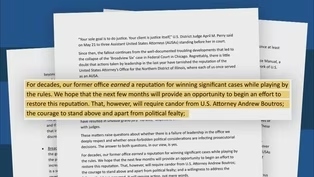
NewFormer Federal Prosecutors Blast US Attorney Andrew Boutros in Open Letter
Video has Closed Captions
The federal prosecutor is under fire for his office's handling of the "Broadview Six" case. (10m 10s)
Providing Support for PBS.org
Learn Moreabout PBS online sponsorship New Episode
- News and Public Affairs

Top journalists deliver compelling original analysis of the hour's headlines.

- News and Public Affairs

Today's top journalists discuss Washington's current political events and public affairs.

 New Episode






 New Episode
 New Episode
Support for PBS provided by:
Chicago Tonight is a local public television program presented by WTTW
WTTW video streaming support provided by members and sponsors.