
Taking Note — Dmitry Yudin
Special | 10m 52sVideo has Closed Captions
Pianist Dmitry Yudin immigrated from Moscow to the United States to follow his older sister.
After taking up the piano at age five and being inspired by Beethoven, Dmitry Yudin immigrated from Moscow to the United States to follow his older sister. Here, he entered the Manhattan School of Music and was heavily influenced by his teacher, Horacio Gutiérrez, who shaped how he looks at music.
Problems playing video? | Closed Captioning Feedback
Problems playing video? | Closed Captioning Feedback
Major series funding for GREAT PERFORMANCES is provided by The Joseph & Robert Cornell Memorial Foundation, the Anna-Maria and Stephen Kellen Arts Fund, the LuEsther T. Mertz Charitable Trust, Sue...
Support provided by:

Taking Note — Dmitry Yudin
Special | 10m 52sVideo has Closed Captions
After taking up the piano at age five and being inspired by Beethoven, Dmitry Yudin immigrated from Moscow to the United States to follow his older sister. Here, he entered the Manhattan School of Music and was heavily influenced by his teacher, Horacio Gutiérrez, who shaped how he looks at music.
Problems playing video? | Closed Captioning Feedback
Where to Watch Great Performances
Great Performances is available to stream on pbs.org and the PBS app.
Buy Now
Great Performances Newsletter
Subscribe to the Great Performances newsletter to keep up with the latest full episodes to stream, exclusive content, and more!Providing Support for PBS.org
Learn Moreabout PBS online sponsorshipMore from This Collection
Taking Note is a new digital series spotlighting rising instrumentalists who have received Career Grant Awards from the Avery Fisher Artist Program. Each year, the program awards $25,000 to instrumentalists and chamber ensembles in support of professional music development.
Video has Closed Captions
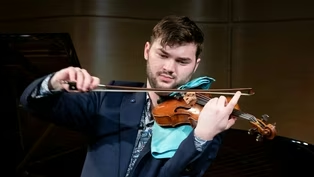
Nathan Meltzer first picked up the violin while living in Vienna and attending elementary school. (16m 16s)
Video has Closed Captions
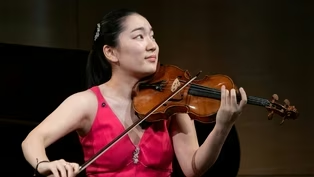
First taking up the violin at age three, Keila Wakao was raised in a musical family. (11m 55s)
Video has Closed Captions
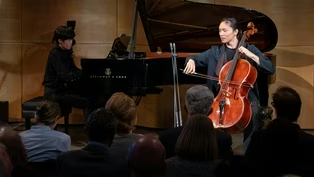
Cellist Leland Ko shares the impact his teachers have had on him on his musical journey. (14m 8s)
Video has Closed Captions
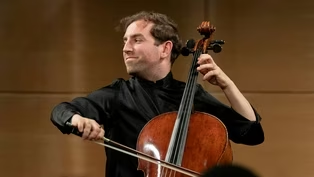
Cellist Tommy Mesa's love of music began with his interest in playing drums. (10m 44s)
Video has Closed Captions
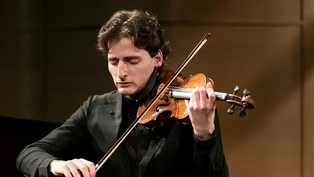
Following in his brother’s footsteps, Joshua Brown picked up the violin at age two. (9m 3s)
Video has Closed Captions
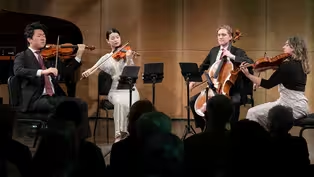
Composed of violinists Lucy Wang and Hao Zhou, violist Aiden Kane, and cellist Tate Zawadiuk. (11m 54s)
Video has Closed Captions
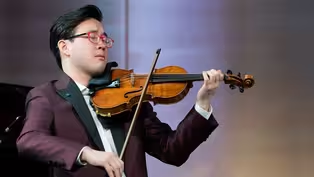
A profile of violinist Julian Rhee, winner of a 2024 Avery Fisher Career Grant Award. (10m 11s)

Taking Note - Balourdet Quartet
Video has Closed Captions
A profile of Balourdet Quartet, winner of a 2024 Avery Fisher Career Grant Award. (9m 18s)
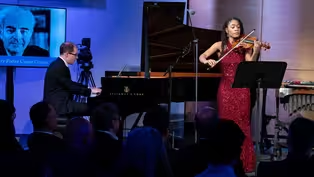
Taking Note - Njioma Chinyere Grevious
Video has Closed Captions
A profile of violinist Njioma Chinyere Grevious, winner of a 2024 Avery Fisher Career Grant Award. (8m 41s)
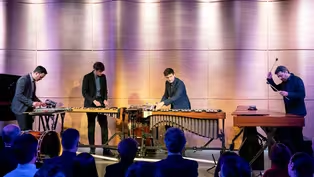
Taking Note - Sandbox Percussion
Video has Closed Captions
A profile of Sandbox Percussion, winner of a 2024 Avery Fisher Career Grant Award. (10m 4s)
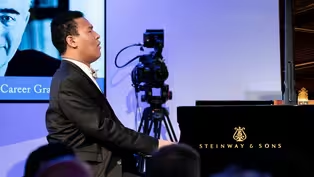
Taking Note - Clayton Stephenson
Video has Closed Captions
A profile of pianist Clayton Stephenson, winner of a 2024 Avery Fisher Career Grant Award. (9m 57s)
Providing Support for PBS.org
Learn Moreabout PBS online sponsorshipApparently I started conducting on, on the music that I heard, and my parents probably decided that something was wrong with me, and they and they decided to show me to our neighbor, who was a violinist.
♪♪ I learned that I won the Avery Fisher Career Grant back in December.
I remember I was in the Beethoven competition in Bonn during the time, and it was exactly the day before I had to play my first round.
I honestly at the moment I couldn't even really say anything.
I was, I was, I was so shocked and probably I sounded like an idiot on the phone.
And then after I processed a little bit, what happened I was ecstatic.
[laughs] ♪♪ So I started formally studying when I was five, but the interest was awakened in me a little bit before that.
My musical journey started with listening to a lot of Beethoven CDs that we had, and then apparently I started conducting on, on the music that I heard.
And my parents, probably decided that something was wrong with me, and they and they decided to show me to our neighbor, who was a violinist, and she was teaching violin in the music school.
And my parents were asking her what to do with me.
And then she told them to show me to the music school, to a one teacher, a friend of hers, that was teaching there.
And so that's how I started.
My decision of moving from Moscow to the US was.
I guess, ruled by several reasons.
First of all, there was more of a family reason.
My sister, my older sister, she moved to the US before me.
She moved in, I think was 2013 and she was studying in the US as well.
And she was far away from all of us.
And we were actually thinking to move to so she would be a little bit closer.
And the second reason was studying with my teacher, Mr.
Horacio Gutiérrez and with whom I had had a huge honor to study for six years until the last year.
And he he saw such an important person to me, maybe one of the most important people in my life.
He changed maybe the the way I, I look and listen to the music now and the way I play in general.
And he had the big he was a big influence on me as a person as well, because all these lessons, besides being very informative musically, we were always talking about different things after lessons and, you know, just taking things and listening from such an educated, larger than life person than him, as him.
That was something that I think probably has changed me a lot in this six years.
♪♪♪ It didn't cross my mind at the time, to be honest.
But, you know, Rachmaninoff was also an émigré to, to the U.S.
as well.
Not that I'm ever comparing myself to Rachmaninoff, but, you know, there's there's some kind of a thing between me and him, I guess.
And, you know, he had maybe more difficult time because it was very different world.
And he had a more difficult time to get adjusted to the American culture, to everything around him here, because I believe it was probably... The move like this was much more fatal at, at his time, because once you move, very likely you you either will not come back or you will come back many, many, many years later when you will maybe have a different country in front of your eyes.
So that move was even was much more brave and very, very different.
Mine was basically an experiment, if I might say so, because I was thinking if I if I might not like it here for some reason, I can always come back.
Then of course, you know, whatever happened, happened in Russia.
And now now things are a little bit different.
And I feel at home here.
♪♪ The Études-Tableaux I remember very clearly what motivated me to play them.
I was at a recital of one of Mr.
Gutierrez's former students, and he was playing the whole opus of Études-Tableaux by Rachmaninoff, Opus 33.
For some reason I never really appreciated this work exactly at the at the beginning, and then after listening to them in the recital, I thought, oh, maybe I was very wrong about them.
And I decided to learn them all.
♪♪ Even though I've been playing them for two years already, I still feel like I'm in the beginning of my path with them and that hopefully our relationship will develop further and further and it will grow deeper as well.
And I hope I will be able to maybe understand something more about this music as well.
♪♪ Of course, we do have the images when we play, but it is very hard to catch them in their particular face.
It is always some fragments, some excerpts that you maybe might visual, might visualize, or you might imagine them in your sound.
But.
You know, if you ask, and I'm sure there are some musicians who will also agree with me.
If you ask about particular images, it might be very hard to respond, because once you're on stage and you're playing music, in a way all the images impact you and you're free of them at the same time.
And it's a feeling that is very hard to describe, but it is within you.
It's not something that you get from outside.
It's everything that you've lived through that you've seen, that you've experienced.
Maybe your home culture is in the mix as well, and hopefully all of that is in your playing.
But to come up with something particular is very, very hard.
♪♪ These two works to me are what Russia to me is about.
This... The bells that you can hear in both the Études-Tableaux and the prelude in a very different way.
But the bells, it was Rachmaninoff theme through all his works, basically.
And this to me, you know, is one of the symbols in Russia, the Russian church.
It sounds very much like home to me.
♪♪ I have given some thoughts on what I will be doing with with the award, and I think if I might announce it already, I would like to find my own personal project.
On playing American music in several concerts I will emphasize certain periods, such as maybe Civil War, World War Two, Vietnam, all the key periods for American history.
And I will play music of these periods.
♪♪ I took a course on jazz pianists.
I was obsessed, I became obsessed with jazz, and I think I was listening to and playing it almost as much as the classical repertoire.
Classical piano had every right to be a little bit jealous of, you know, revealing that I have a mistress in the in the jazz side of things.
[laughs]
 New Episode
- Arts and Music

Innovative musicians from every genre perform live in the longest-running music series.

- Arts and Music
The Best of the Joy of Painting with Bob Ross
A pop icon, Bob Ross offers soothing words of wisdom as he paints captivating landscapes.







 New Episode
 New Episode
Support for PBS provided by:
Major series funding for GREAT PERFORMANCES is provided by The Joseph & Robert Cornell Memorial Foundation, the Anna-Maria and Stephen Kellen Arts Fund, the LuEsther T. Mertz Charitable Trust, Sue...