
What to know about South Carolina’s big measles outbreak
Clip: 2/5/2026 | 6m 43sVideo has Closed Captions
What to know about South Carolina’s big measles outbreak and who is most at risk
South Carolina is experiencing one of the biggest measles outbreaks the U.S. has seen in decades. In that state, there are 876 confirmed cases of the highly contagious virus, which is preventable with a vaccine. While the current surge may be slowing, doctors warn there are still serious risks for vulnerable populations. William Brangham speaks with epidemiologist Katelyn Jetelina for more.
Problems playing video? | Closed Captioning Feedback
Problems playing video? | Closed Captioning Feedback
Major corporate funding for the PBS News Hour is provided by BDO, BNSF, Consumer Cellular, American Cruise Lines, and Raymond James. Funding for the PBS NewsHour Weekend is provided by...
Support provided by:

What to know about South Carolina’s big measles outbreak
Clip: 2/5/2026 | 6m 43sVideo has Closed Captions
South Carolina is experiencing one of the biggest measles outbreaks the U.S. has seen in decades. In that state, there are 876 confirmed cases of the highly contagious virus, which is preventable with a vaccine. While the current surge may be slowing, doctors warn there are still serious risks for vulnerable populations. William Brangham speaks with epidemiologist Katelyn Jetelina for more.
Problems playing video? | Closed Captioning Feedback
How to Watch PBS News Hour
PBS News Hour is available to stream on pbs.org and the free PBS App, available on iPhone, Apple TV, Android TV, Android smartphones, Amazon Fire TV, Amazon Fire Tablet, Roku, Samsung Smart TV, and Vizio.
Providing Support for PBS.org
Learn Moreabout PBS online sponsorshipWILLIAM BRANGHAM: Measles continues to# spread in the U.S., with South Carolina## currently experiencing the biggest outbreak# it's seen in decades.
In that state, there are## 876 confirmed cases of the highly contagious# virus, which is preventable with a vaccine.
This current surge may be slowing.
New cases# aren't rising as fast and vaccinations have## picked up.
But doctors warn there are still# serious risks for vulnerable populations,## including children and pregnant women.
For more we are joined again by Katelyn Jetelina.## She writes the excellent newsletter# called Your Local Epidemiologist.
Katelyn, thanks so much for being here.
How serious is this outbreak# in South Carolina?
I mean,## how would you compare it to past outbreaks?# And how did it get this bad this quickly?
KATELYN JETELINA, Your Local Epidemiologist# Substack: Yes, this outbreak in South Carolina## is bad, and it is historically# large, like you said, 876 cases.
And this is larger than any other# recent landmark U.S.
outbreak.
In 2025,## the West Texas outbreak ended# at 762 cases.
In New York City,## the 2019 outbreak had 649 cases.
So this# is one of the largest outbreaks in decades,## and certainly the largest since the U.S.# achieved measles elimination in 2000.
This is also concerning because of the# timing.
Measles is usually quieter in## January and February.
It usually really# picks up in the spring.
And the reason## this is happening is, the core driver# is susceptibility.
We have pockets,## and these pockets are getting larger# and larger, of low vaccination rates.
And given that measles is the most contagious# virus in the world, it will find those pockets.## It's like kindling, and once it gets# caught, it can spread like wildfire.
WILLIAM BRANGHAM: And, again, can# you remind us why we really worry## about measles and why we want to keep it at bay?
KATELYN JETELINA: Well, measles is preventable.# We have a highly effective and very safe vaccine,## far safer than the virus itself.
And it# does impact children, especially those## younger that don't have a really strong immune# system and can't protect themselves, right?
Kids under the age of 12 months are too# young to get the vaccine.
Immunocompromised## also don't hit an immune response with the# vaccine.
And even if you do get infected,## one thing that measles can do# is, it can cause hearing loss,## it can cause death, but it can also# wipe out your immune system memory.
And so we actually end up seeing death later# on from, like, flu or other viruses because## your immune system memory gets wiped# out from measles.
It's a nasty virus.
WILLIAM BRANGHAM: There are some# signs that vaccination rates in## South Carolina have been going up.# And that's obviously great news.## How long -- if someone goes and gets a# shot today, how long does it take for## the body to respond and develop an immune# response and really give you protection?
KATELYN JETELINA: Yes, so, typically, like,# the full protection takes about two weeks,## but if you're exposed to measles# and you have not been vaccinated,## you can still get protection in# a few days after your exposure.
And this really helps not# necessarily to avoid infection,## but it'll help avoid you going to# the hospital and dying.
And so,## even if you're exposed, even if you haven't been# vaccinated before, it certainly isn't too late.
WILLIAM BRANGHAM: You wrote something# recently that caught my eye.
You were suggesting in some way that our# success in public health over the decades,## the last 100 or so years, through all sorts# of means of modern medicine and sanitation,## but especially vaccines, that some# people have somewhat forgotten## the bad old days of when viruses# and bacteria really ran rampant.
Do you think that is what's happening here?
KATELYN JETELINA: I think we find ourselves at## the intersection of several# forces colliding, honestly.
But, yes, collective amnesia, general# amnesia is certainly at play.
Vaccines## are a victim of their own success.
I'm a# mom.
I have a 5- and 6-year-old.
I have## never had a girlfriend with their kids# get measles.
I have never seen polio.
A## lot of my physician friends# have never had to treat it.
And so I think, rightfully so, a# lot of people have questions and## concerns and confusion why we vaccinate# in the first place.
And, unfortunately,## that means our vaccination rates are decreasing# slowly over time, and also colliding, like I said,## with other forces, right, global instability, a# radically changed online information ecosystem,## bad actors exploiting these spaces, and a# lot of deepening mistrust in institutions.
WILLIAM BRANGHAM: You mentioned# before that this is one of the## worst outbreaks since we had the official# designation as being a measles-free nation.
Many people believe that we are# about to lose that designation again,## according to the WHO.
What does that matter on a# practical basis?
Does it actually mean anything?
KATELYN JETELINA: Not really# to the general public.
What this basically is, is a sign that# -- a national warning light, right,## that we are moving backwards for children's# health.
The core question, like you said,## we're trying to answer is, is measles# endemic again, right?
Is it spreading## from pocket to pocket, rather# than sporadic or random outbreaks?
And, like you said, all signs are pointing# that we are in the United States likely going## to lose our elimination status probably# in April.
But this also isn't just a U.S.## story.
A lot of our neighbors, our country# -- our friends of other countries, right,## our neighbors in Canada and Mexico,# are also having really big outbreaks.
Our friends over in Europe, six countries# just lost their measles elimination status,## including the U.K.
and Spain.# So this is a global phenomenon.## We certainly are also feeling# it here in the United States.
WILLIAM BRANGHAM: Katelyn Jetelina, always great# to talk to you.
Thank you so much for being here.
KATELYN JETELINA: Yes, thank you for having me.
The complicated road to recovery for Indian sex workers
Video has Closed Captions
Clip: 2/5/2026 | 8m 58s | The complicated road to recovery for Indian women forced into sex work (8m 58s)
How public opinion against ICE may affect funding showdown
Video has Closed Captions
Clip: 2/5/2026 | 5m 23s | How public opinion shifting against ICE may affect the DHS funding showdown in Congress (5m 23s)

How ‘zombie mortgages’ are coming back to haunt homeowners
Video has Closed Captions
Clip: 2/5/2026 | 10m 51s | How ‘zombie mortgages’ are coming back to haunt homeowners years later (10m 51s)
Humanitarian group head urges nations to step up Sudan aid
Video has Closed Captions
Clip: 2/5/2026 | 5m 43s | Head of humanitarian group urges nations to step up Sudan aid to prevent ‘biblical’ famine (5m 43s)

News Wrap: Trump rejects extension of New START treaty
Video has Closed Captions
Clip: 2/5/2026 | 5m 54s | News Wrap: Trump rejects extension of expired U.S.-Russia nuclear arms treaty (5m 54s)
RSF siege of Sudanese city leaves overwhelming suffering
Video has Closed Captions
Clip: 2/5/2026 | 5m 7s | Sudanese army finds overwhelming suffering after breaking RSF siege of embattled city (5m 7s)
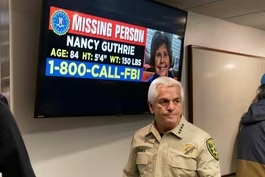
Search continues for Nancy Guthrie as authorities seek leads
Video has Closed Captions
Clip: 2/5/2026 | 3m 45s | Search continues for Nancy Guthrie as authorities seek leads to find suspects (3m 45s)
Providing Support for PBS.org
Learn Moreabout PBS online sponsorship
- News and Public Affairs

FRONTLINE is investigative journalism that questions, explains and changes our world.

- News and Public Affairs

Amanpour and Company features conversations with leaders and decision makers.











Out Of The Dark: Teens Talk Mental Health
Support for PBS provided by:
Major corporate funding for the PBS News Hour is provided by BDO, BNSF, Consumer Cellular, American Cruise Lines, and Raymond James. Funding for the PBS NewsHour Weekend is provided by...