
Israel, Lebanon to talk as strikes threaten U.S.-Iran truce
Clip: 4/9/2026 | 6m 58sVideo has Closed Captions
Israel agrees to talks with Lebanon as strikes there threaten fragile U.S.-Iran truce
Israel agreed to negotiations with Lebanon as its continued strikes are jeopardizing the fragile ceasefire between the U.S. and Iran. It comes as American and Iranian diplomats are set to meet in Pakistan, but a wide gulf of trust and lack of clarity threatens this possible end to five-plus weeks of fighting. Special correspondent Simona Foltyn reports.
Problems playing video? | Closed Captioning Feedback
Problems playing video? | Closed Captioning Feedback
Major corporate funding for the PBS News Hour is provided by BDO, BNSF, Consumer Cellular, American Cruise Lines, and Raymond James. Funding for the PBS NewsHour Weekend is provided by...
Israel, Lebanon to talk as strikes threaten U.S.-Iran truce
Clip: 4/9/2026 | 6m 58sVideo has Closed Captions
Israel agreed to negotiations with Lebanon as its continued strikes are jeopardizing the fragile ceasefire between the U.S. and Iran. It comes as American and Iranian diplomats are set to meet in Pakistan, but a wide gulf of trust and lack of clarity threatens this possible end to five-plus weeks of fighting. Special correspondent Simona Foltyn reports.
Problems playing video? | Closed Captioning Feedback
How to Watch PBS News Hour
PBS News Hour is available to stream on pbs.org and the free PBS App, available on iPhone, Apple TV, Android TV, Android smartphones, Amazon Fire TV, Amazon Fire Tablet, Roku, Samsung Smart TV, and Vizio.
Providing Support for PBS.org
Learn Moreabout PBS online sponsorshipWelcome to the NewsHour.
Israel has agreed to negotiations with Lebanon as it continued strikes on Beirut today.
The bombing across Lebanon is jeopardizing the fragile ceasefire between the US and Iran.
It comes as American and Iranian diplomats are set to meet in Pakistan this weekend.
But a wide gulf of trust and lack of clarity on demands threatens this possible end to more than five weeks of fighting.
Special correspondent Simona Fine starts our coverage from Lebanon.
still reeling from the deadliest day of Israeli attacks since the start of the wider war with Iran.
Rescue teams in Beirut have been working around the clock since Israel unleashed an unprecedented wave of attacks yesterday.
18 people have been pulled dead from the rubble of this building alone.
There's little hope for the four still buried underneath.
But the civil defense isn't giving up until everyone is accounted for.
We are currently carrying out this search and rescue operation the fastest we can.
We came here so we can implement this mission and so that we can recover the four missing victims.
Volunteer Ali Khaled Hab came to the capital as part of reinforcements sent from other parts of the country.
There is a drone in the sky right now.
The strikes are still ongoing.
Are you worried about your safety?
It's not just a worry.
It's a risk above our head.
This constant annoying sound that's making us nervous.
So yes, we are a bit distracted, but we will stay here to complete the mission.
In just 10 minutes, Israeli war planes carried out more than 100 strikes, killing more than 300 and injuring more than a thousand in one of the bloodiest days in Lebanon's recent history.
Israel says it was targeting Hezbollah.
The strikes hit densely populated residential neighborhoods, exacting a heavy civilian toll.
Scenes of devastation like this one are repeated across the capital Beirut in areas that were previously deemed safe.
That perception of relative safety has been completely shattered.
There is a profound feeling of shock, uncertainty, and fear that there are no guard rails to prevent this war from escalating further.
President Trump has pushed Israel to scale back attacks on Lebanon.
And today, Prime Minister Benjamin Netanyahu agreed to direct negotiations.
I instructed the cabinet to open direct negotiations with Lebanon in order to achieve two goals.
One, the disarmament of Hezbollah.
Two, a historic sustainable peace agreement between Israel and Lebanon.
The direct talks slated to be in Washington would be the first such negotiation between the two countries in decades.
As those negotiations play out, President Trump vowed US troops, aircraft, and the fleet of warships in the region aren't going anywhere until the quote real agreement is reached and fully complied with.
He added, "The US military is looking forward actually to its next conquest."
It comes as President Trump has heavily criticized the NATO alliance for what he says is a lack of support for the US war effort in Iran.
Allies are doing everything the United States is asking.
In Washington one day after meeting with the president, NATO Secretary General Mar signaled support for the US military and that the alliance may play a role in securing the state of Hormuz.
But what I see when I look across Europe today is allies providing a massive amount of support, basing, logistics, and other measures to ensure the powerful US military succeeds in denying Iran a nuclear weapon and degrading its capacity to export chaos.
But Iran remains defiant.
The Supreme Leader Macham put out a statement today declaring victory for the Iranian people.
A news anchor read it out on state TV.
It is clear before everyone's eyes the dawn of the Islamic Republic's emergence as a great power while the evil is facing the downhill slope of weakness.
For many Lebanese mourning their loved ones and picking through the rubble of their homes, promises of a ceasefire deal, let alone peace with Israel, seem more elusive than ever.
Ali Muhammad survived the strike on this building in central Beirut.
His living quarters were on the lower ground floor, which is likely why he escaped unharmed.
The dental clinic right above him was completely destroyed.
I was in my room downstairs and suddenly the rockets came down, hitting this dental clinic.
The ceiling came down on us.
There was no warning.
The place was full of dust.
It took 10 to 15 minutes until I could see anything.
So, I could open the door and escape through a small crack.
Rah has worked as the building's attendant for 5 years.
He knew each and every person who lived here and said none of the residents were affiliated with Hezbollah.
Our building has seven floors.
All of the residents are civilians.
There's no one else here.
The building across the street was also targeted and completely raised to the ground.
The IDF said it expanded its military campaign to neighborhoods like these because Hezbollah had moved outside its traditional areas of control.
But it has provided no evidence to support these claims.
In the wake of so much loss, accusations are swirling around fueled by paranoia and growing internal rifts among Lebanese.
This woman who lives in the neighborhood came up to us to say that she saw suspicious movements in and out of the building that was demolished.
She wanted to remain anonymous out of fear for her safety.
For 2 years, we've been saying that there are trucks entering the building that we are suspicious of.
They've entered several times.
We couldn't verify these claims.
Another neighbor told us that authorities reportedly inspected the building and found nothing.
Even if Hezbollah was present here, international law still requires Israel to observe principles of proportionality and precaution to prevent civilian harm.
But yesterday's air raids were all but proportional and they came without warning.
Lebanon's Prime Minister Naw Salam said the government would file a complaint to the UN Security Council.
This dangerous escalation comes in defiance of all international and regional efforts to end the war in the region and blatantly disregards the principles of international law and international humanitarian law.
Indeed, it flagrantly violates them.
The prime minister repeated calls to disarm Hezbollah.
The army and security forces are required to immediately begin enhancing the state's full authority across Beirut and restricting arms to legitimate forces only.
That process was ongoing before the war escalated last month.
The Lebanese army had confiscated much of Hezbollah's weaponry in Lebanon south, completing the first of a precarious five-phase plan to disarm the militant group.
But army officials have said it's not feasible to take Hezbollah's weapons by force and as long as Israel keeps attacking and occupying the country.
For the PBS NewsHour, I'm Simona Faline in Beirut, Lebanon.
Support journalism you trust.
Support PBS News.
Donate now or even better, start a monthly contribution today.
 New
NewAnthropic’s new AI model raises fears about high-tech risks
Video has Closed Captions
Anthropic’s powerful new AI model raises concerns about high-tech risks (6m 19s)
 New
NewInside Chicago's Steppenwolf Theatre as it marks 50 years
Video has Closed Captions
Inside Chicago's innovative Steppenwolf Theatre Company as it marks 50 years (6m 39s)
 New
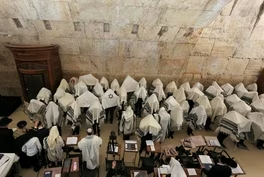
NewIsraelis mark Passover in shadow of war
Video has Closed Captions
Israelis mark Passover in shadow of war: 'We cannot celebrate together' (5m 10s)
 New
NewMelania Trump denies close relationship with Epstein
Video has Closed Captions
In rare public address, Melania Trump denies close relationship with Epstein (2m 31s)
 New
NewNews Wrap: NASA optimistic ahead of Artemis II reentry
Video has Closed Captions
News Wrap: NASA optimistic ahead of Artemis II reentry (5m 28s)
 New
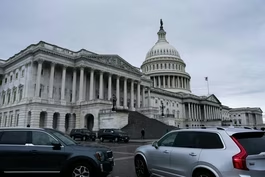
NewTrump’s Iran rhetoric faces scrutiny as Congress returns
Video has Closed Captions
Trump’s Iran strategy and rhetoric face scrutiny as Congress returns from recess (5m)
 New
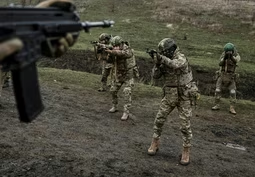
NewUkraine faces military desertions as Russian war grinds on
Video has Closed Captions
Ukraine faces military desertions as Russian invasion grinds through 5th year (8m 41s)
 New
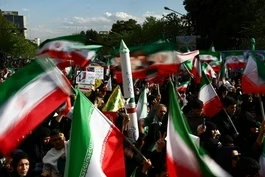
NewWhat Iranians are saying about the war and their government
Video has Closed Captions
What people in Iran are saying about the war and their government (5m 23s)
Providing Support for PBS.org
Learn Moreabout PBS online sponsorship
- News and Public Affairs

FRONTLINE is investigative journalism that questions, explains and changes our world.

- News and Public Affairs

Amanpour and Company features conversations with leaders and decision makers.












Support for PBS provided by:
Major corporate funding for the PBS News Hour is provided by BDO, BNSF, Consumer Cellular, American Cruise Lines, and Raymond James. Funding for the PBS NewsHour Weekend is provided by...