
Yellowstone: Secrets Beneath Yellowstone
Special | 7m 34sVideo has Closed Captions
What are Yellowstone National Park's five types of thermal features?
Yellowstone is the world's first national park and a geological wonder. The park is home to five kinds of thermal features: geysers, hot springs, mud pots, fumaroles, and travertine terraces. Learn more about these features and how a hot spot near the Earth's surface fuels these wonders.
Problems playing video? | Closed Captioning Feedback
Problems playing video? | Closed Captioning Feedback
Science Trek is a local public television program presented by IdahoPTV
Major Funding by the Laura Moore Cunningham Foundation and the Idaho National Laboratory. Additional Funding by the Friends of Idaho Public Television and the Corporation for Public Broadcasting.
Yellowstone: Secrets Beneath Yellowstone
Special | 7m 34sVideo has Closed Captions
Yellowstone is the world's first national park and a geological wonder. The park is home to five kinds of thermal features: geysers, hot springs, mud pots, fumaroles, and travertine terraces. Learn more about these features and how a hot spot near the Earth's surface fuels these wonders.
Problems playing video? | Closed Captioning Feedback
How to Watch Science Trek
Science Trek is available to stream on pbs.org and the free PBS App, available on iPhone, Apple TV, Android TV, Android smartphones, Amazon Fire TV, Amazon Fire Tablet, Roku, Samsung Smart TV, and Vizio.
Science Trek
Science Trek is a place where parents, kids, and educators can watch short, educational videos on a variety of science topics. Every Monday Science Trek releases a new video that introduces children to math, science, technology, engineering, and math (STEM) career potentials in a fun, informative way.Part of These Collections
Earth Science
Earth Science is the study of the earth. Learn about the place we call home.
View Collection
Providing Support for PBS.org
Learn Moreabout PBS online sponsorshipJOAN CARTAN-HANSEN, HOST: Yellowstone is the world's first national park.
It was home to native Americans for thousands of years.
But when John Colter, a former member of the Lewis and Clark expedition, explored the area and then returned home to tell people about it, people didn't believe him!
So, let's go explore Yellowstone and, in this episode, learn about the park's geological wonders.
[MUSIC] STUDENT ONE: I just don't know what to do.
STUDENT TWO: What's the problem?
STUDENT ONE: I have to do a geology report on one part of the Earth, and I just don't know where to start.
CARTAN-HANSEN: Have you thought about Yellowstone National Park?
STUDENT ONE: Hi, Joan.
Why Yellowstone?
CARTAN-HANSEN: Because it's a geological wonderland.
Let me take you on a tour.
STUDENT ONE: What's this?
CARTAN-HANSEN: It's a map showing a hot spot.
STUDENT TWO: What's a hot spot?
Scott Hughes, Idaho State University: A hotspot on the surface of the earth really, truly is exactly what it says, A place where there's a lot of heat coming up.
CARTAN-HANSEN: Yellowstone National Park sits on top of a hot spot.. A large chamber of melted rock or magma that sits just a few miles below the surface.
Over millions of years, the tectonic plate over this hot spot moved from the Oregon/Nevada border, across southern Idaho to where it is now underneath Yellowstone national park.
It continues to move about one point eight inches or four point six centimeters per year.
That's slightly faster than how much your fingernails grow.
STUDENT ONE: Huh.
So, what does a hot spot do?
CARTAN-HANSEN: Because the Yellowstone hot spot is only about three miles beneath the surface of the ground, it's the source for the geothermal activity.
STUDENT TWO: Geothermal activity?
What's that?
CARTAN-HANSEN: Geothermal means heat from the ground.
A gigantic magma chamber powers Yellowstone's more than ten thousand thermal features.
And Yellowstone has five basic types of thermal features.
Let's start with geyers.
[GEYSER ERUPTING] Old Faithful is Yellowstone's most famous geyser.
It's one of 500 in the park.
[GEYSER SPEWING] A geyser forms when rain and snow sink into the ground to about 10 thousand feet.
There, the water meets layers of rocks heated by a chamber of magma.
The water is superheated to over 400 degrees Fahrenheit.
HUGHES: So, when the water gets really hot, hot enough to boil under pressure, it comes back up and there are pockets that when the water heats up enough so that it can explode, in other words, violently expand... [GEYSER ERUPTING] ... to steam or to water vapor, it shoots up a geyser.
Now, when the geyser it blasts up, it vacates those pockets of water and so then it shuts off.
So, the water has to fill in and reheat itself.
CARTAN-HANSEN: Old Faithful is called that because it erupts every 60 to 110 minutes.
Other geysers in the park aren't as faithful.
Some have gone as long as 50 years between eruptions.
Hot springs are the most common hydrothermal feature in Yellowstone.
Just as in a geyser, rain and snow seep into the bedrock and gets superheated.
But because the cracks in the rock or the plumbing system is open the hot water rises to the surface and creates a pool.
STUDENT TWO: Why are some hot pools so colorful?
HUGHES: The different types of bacteria are different colors, but there are some that thrive at different temperature levels so that as the pool gets shallower and shallower to the edges, it's actually cooler and those cooler zones have a different organism that's growing there.
Whereas in the center, it's really hot, not much grows there, it's really nice and clear.
CARTAN-HANSEN: My favorite thermal features in Yellowstone are mud pots.
[MUD POTS BUBBLING] These bubbling, smelly, noisy features are a kind of hot spring.
HUGHES: Mud pot is where the water table is down at depth.
And so, the acids in the water, and its carbonic acid mostly, when you take carbon dioxide and dissolve it in water or sulfur dioxide, sulfuric acid, these acids will actually attack the rock above the water table.
And when it attacks the rocks, it actually changes the minerals of the rocks.
It causes them to break down and reform as clay.
CARTAN-HANSEN: A rotten egg smelling gas called hydrogen sulfide gets released.
It also creates sulfuric acid, which dissolves the surrounding rock.
The water and gas mix with clay and minerals and makes a boiling mud pit.
Fumaroles or steam vents are the next type of geothermal feature.
These have so little water in their underground system that all that reaches the surface is steam.
They hiss or whistle as the superheated steam is released.
[STEAM HISSING] The last thermal feature are the travertine terraces STUDENT TWO: What's that?
CARTAN-HANSEN: Yellowstone's travertine terraces are formed from limestone.
HUGHES: When the hot water comes through that limestone, it is coming up normally because it's heated and it expands and it comes to the surface and flows out on the surface.
It is full of calcium carbonate, dissolved calcium carbonate.
When water carrying a lot of calcium carbonate starts to flow out, and as the water evaporates, it deposits a little bit of calcium carbonate.
And so we have these terraces.
CARTAN-HANSEN: The calcium carbonate deposits a chalky, white mineral and forms the rock, travertine.
Over time, the deposits create terraces.
Making it look like sort of a frozen waterfall.
The colors in the travertine are due to those same microscopic creatures found in hot springs.
HUGHES: Yellowstone is just a special place.
Anytime I ever get in a situation where I can tell anybody to enjoy the outdoors, do so.
Enjoy it.
Take care of it.
Leave only footprints and do whatever you can to make sure that everybody else knows that these places are to be cherished.
They are treasures.
STUDENT ONE: Wow!
That's perfect for my geology report.
Thanks Joan!
STUDENT TWO: But what about my biology report?
CARTAN-HANSEN: Ah, the answer to that is in my other Yellowstone video.
In the meantime, if you want to learn more about Yellowstone, check out the Science Trek website.
You'll find it at ScienceTrek.org.
[MUSIC] Announcer: Presentation of Science Trek on Idaho Public Television is made possible through the generous support of the Laura Moore Cunningham Foundation, committed to fulfilling the Moore and Bettis Family legacy of building the great state of Idaho; by the Idaho National Laboratory, mentoring talent and finding solutions for energy and security challenges; by the Friends of Idaho Public Television; and by the Corporation for Public Broadcasting.
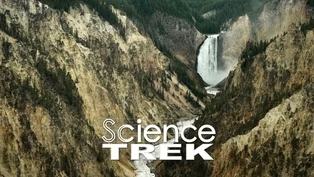
Yellowstone: How Did Yellowstone Get Its Name?
Video has Closed Captions
Clip: Special | 1m 4s | How did Yellowstone National Park get its name? (1m 4s)
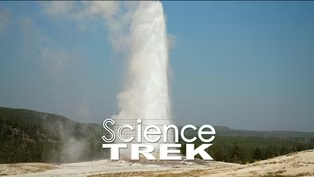
Yellowstone: Is Old Faithful Really Faithful?
Video has Closed Captions
Clip: Special | 1m 4s | How do they tell when Old Faithful will next erupt? (1m 4s)
Providing Support for PBS.org
Learn Moreabout PBS online sponsorship
- Science and Nature

Explore scientific discoveries on television's most acclaimed science documentary series.

- Science and Nature

Capturing the splendor of the natural world, from the African plains to the Antarctic ice.












Support for PBS provided by:
Science Trek is a local public television program presented by IdahoPTV
Major Funding by the Laura Moore Cunningham Foundation and the Idaho National Laboratory. Additional Funding by the Friends of Idaho Public Television and the Corporation for Public Broadcasting.