
Episode 1
Season 3 Episode 1 | 54m 55sVideo has Closed Captions
Lucy Worsley investigates the explosive 18th century break up of Britain and America.
Lucy Worsley investigates the tensions and turning points that led to America’s declaration of independence from Britain in 1776. With access to expert insights and original evidence, Lucy asks whether this explosive split could have been avoided.
Problems playing video? | Closed Captioning Feedback
Problems playing video? | Closed Captioning Feedback
Episode 1
Season 3 Episode 1 | 54m 55sVideo has Closed Captions
Lucy Worsley investigates the tensions and turning points that led to America’s declaration of independence from Britain in 1776. With access to expert insights and original evidence, Lucy asks whether this explosive split could have been avoided.
Problems playing video? | Closed Captioning Feedback
How to Watch Lucy Worsley Investigates
Lucy Worsley Investigates is available to stream on pbs.org and the free PBS App, available on iPhone, Apple TV, Android TV, Android smartphones, Amazon Fire TV, Amazon Fire Tablet, Roku, Samsung Smart TV, and Vizio.
Providing Support for PBS.org
Learn Moreabout PBS online sponsorship♪ Worsley: July 1776, New York.
American revolutionaries attack the statue of King George III.
[Men shouting] [Stone breaking] They hack off the head of the statue and declare their independence from Britain and its king.
But what led to this breakup?
Was it bad decisions?
The fatal errors that drove the American colonies to war against Britain.
And how close did we come to a different result?
♪ In this two-part special, I'm reinvestigating one of the most explosive breakups between two nations in history.
This is the Stamp Act.
The whole mess starts here, Lucy.
[Shouting] Worsley: It's a story that's become part of the mythology of both Britain and the United States... Oh, look at that.
You can just imagine inviting your friends round for a seditious tea party.
Worsley: told as a bitter loss of empire... It was the closest we came to an anarchy.
Worsley: or the triumphant birth of a new nation.
He is outnumbered just about two to one.
Worsley: But 250 years since America's Declaration of Independence, there's an untold version of the story.
The British perspective.
That's what I want to investigate.
Think James Bond wearing a powdered wig.
Listen to this.
He's giving up the throne.
He's resigning his job.
I'm going to uncover forgotten witnesses.
It's like opening a present.
I'm going to re-examine the original evidence.
Damn you.
Fire!
And follow new clues... [Electricity buzzes] [Screams] to get closer to the truth.
Historians have very different views.
What do you think?
♪ ♪ It's hard to imagine, but 250 years ago, this quiet park in New York saw a revolution catching fire.
♪ A war had begun between Britain and its American colonies.
And a group of new American recruits gathered right here.
Some of them were wearing uniforms given to them by the French.
Others were just wearing their own clothes.
And they had all sorts of weapons: old rifles, blunderbusses.
Some people had just a pitchfork.
George Washington, their leader, lined them all up, and he ordered this document to be read to them.
It's the ultimate breakup letter.
It says, "America is breaking up with Britain.
"The relationship is over.
And we really don't like your king."
This is what it has to say about King George III.
That he "wants an absolute Tyranny over these States."
Now famous as the Declaration of Independence, it was the reading of this letter that triggered the crowd to target the statue of George III, perched on horseback like a Roman emperor.
♪ Tucked away in a museum off Central Park, I've discovered there's a weird artifact... [Whirring] that's been preserved from that chaotic day in 1776.
♪ Oh, it's like opening a present.
-Would you like to do it?
-Can I do it?
Thank you.
[Gasps] There it is.
This is... [Chuckles] It's so weird.
This is the tail of the horse of George III from the statue.
Some other bits survived, but this one's the biggest.
And the tail weighs 60 pounds.
I can see where they've been hacking at it.
Someone's gone... [Imitates strike] ...there.
And there too.
[Imitates strike] ♪ This is the most extraordinary thing.
♪ But what happened to the rest of the statue is even more dramatic.
They cut off its head, and the rest of the king's body was chopped up and taken to Connecticut, where it was melted down and turned into 42,000 musket balls.
It's like the king's own body had been turned into ammunition for the American army to fire at his own British redcoats.
♪ The destruction of George's statue shows how deep the anger ran, how personal this war had become.
But what drove Britain and America to such a violent breakup?
The story of the American Revolution is usually told as if the outcome were inevitable.
But I'm not so sure.
I'm going to look at the milestones along the way and the misunderstandings that blew this relationship apart and ask if things could have been different.
♪ I'm beginning my investigation, not in America, but in Britain, at George III's Astronomical Observatory in Richmond, a place full of his passions.
This building tells me that George was a man who thirsted for knowledge about absolutely everything, from the movement of the planets to the state of things in his new empire.
He personally ordered the purchasing of 300 books about his North American colonies so that he could read about subjects ranging from their tax laws to-- heh--the kind of birds you could hear singing in Massachusetts.
♪ Worsley, voice-over: I think there's something here that can help me understand who George was and how he felt about his American colonies.
Ah, here he is.
Here's George in his coronation portrait.
He looks awfully kingly, doesn't he, in his gold satin suit?
To me, he also looks very fresh-faced and young.
♪ I know George III liked to study.
He liked to be well-informed.
As well as books, he had a huge collection of maps, many acquired to mark major moments of his reign.
One of those moments came 13 years before the breakup of Britain and America.
This was when Britain beat France in the Seven Years' War, a victory in which George gained vast territories in North America.
This map, made after the war, absolutely pins down what is British.
The colonies have all got nice, clear-colored borders.
It's clear that George rules everything down the Eastern Seaboard, from Newfoundland, down through New England and Pennsylvania, Virginia, the Carolinas, Georgia, named after his granddad, right down to the Bahamas.
The thing is, George had never actually been to America.
Not once.
His relationship with his colonies there was entirely theoretical.
Could it be that there was a gap between his nice, orderly map and what was really happening?
The American colonies of the 1760s were an integral part of the British Empire.
Each colony had its own local assembly and capital, but ultimate authority still rested in London.
Ships, goods and people crisscrossed the Atlantic, and the Red Ensign flag of Great Britain flew proudly in every colonial port.
Yet, as the colonies prospered, their confidence grew.
They began to want more say in their own affairs.
♪ I want to dig into exactly what they wanted and who was making their case.
One of the most famous of the North American colonists actually lived here in London for 16 years.
He's so famous that he's still on America's money.
Here he is, hundred-dollar bill, Benjamin Franklin.
This is his house in Craven Street, and every morning, he had quite a strange routine.
He'd come to this window here, he'd open it up, and he'd take what he called an air bath.
He'd let the air wash over him, but he did it totally naked.
I don't know what the people across the road thought.
♪ Eccentric, yes, but Franklin was also a shrewd political operator.
He was a media mogul.
He'd run one of America's most influential newspapers.
And when he arrived in London, he clearly made himself feel very comfortable.
♪ -Hello.
Come in.
-Thank you so much.
Welcome to Benjamin Franklin's house.
Thank you.
♪ I'm here to see a replica of a game Franklin invented, a sort of trick he used to play on people here in London.
What have you got in here, Henry?
So, here we have the magical picture game, otherwise known as the treason game.
Essentially, the frame is electrified, so if you can see, the crown is metal, you're going to put your finger on it, say something critical about the king and see what happens.
OK, I don't like the king, I want to steal his crown.
-[Screams] -[Laughs] How much electricity was that?
Um, who knows?
Franklin wrote... -"Who knows?"
-Franklin... You just tried to kill me.
Franklin wrote that it could potentially be fatal, so, luckily, you weren't that treasonous, you did survive, but you got a nasty shock.
Yes, don't mess with George III, that's the message of this game.
Surprisingly, Franklin was really quite the royalist.
But that's not the only revelation.
Everyone thinks of Benjamin Franklin as American, but that's not really true, is it?
No, not at all.
He was British, and anyone who was living in the colonies was a British citizen, and they considered themselves to be one of the counties abroad, basically.
When he comes to London, he has a portrait done, and he pretty much presents himself as a British intellectual.
He has a bust of Isaac Newton looking down at him whilst he's reading.
He's wearing a bright blue coat with gold trimmings, something that would tell the viewer that this is a very important, wealthy individual.
So he can dress to meet the circumstances?
He can.
He wasn't a huge fan of wigs, for example, but when he has his portrait done in London, he's wearing a very fancy wig.
When Franklin was living here in this house in London, what was he doing?
He was sent over by the people of Pennsylvania as a colonial agent to represent their interests in Great Britain, and the Pennsylvanians wanted more power to be moved to America.
Over time, Franklin then becomes a representative of Georgia, New Jersey, Massachusetts, and eventually he adopts this sort of ambassadorial persona.
He's essentially America's first ambassador, and he's representing all American interests in London.
He's actually a voice in the Parliament, able to speak on behalf of North America.
He wasn't a great orator.
His power was in the pen.
So he was writing lots of letters to influential people to try and keep the relationship between America and Britain as a strong one and as a united one.
He's trying to keep that relationship going.
Like a marriage counselor?
Very much so, yes.
♪ Worsley: The charismatic Franklin linked Britain and the 13 American colonies.
He was trying to convince the crown to give America a little more freedom.
But he caught wind of a proposal that would send shockwaves through this finely balanced relationship.
♪ I have an appointment at the National Archives in London to see an infamous document from 1765.
Now, 18th century tax law might not be your idea of wild party times, but I know a man who absolutely loves this stuff.
Perhaps he can tell me if the first tiny cloud on the horizon for the Special Relationship was an argument about money.
♪ Benjamin Franklin himself once wrote, "In this world, nothing is certain except death and taxes."
Frank, I know you want to take me to that one.
You're really excited about that one, aren't you?
I am really excited about that one.
Worsley, voice-over: This is one of the most contentious tax documents in history.
This is the Stamp Act.
The Stamp Act, that's a very famous act.
It's very famous.
The whole mess starts here, Lucy.
[Gasps] With this roll.
With this act.
With this act.
Britain had a huge deficit as a result of its victory in the Seven Years' War.
The British national debt prior to the war was about £70 million.
After the war, it's a hundred... -nearly £140 million.
-It doubled.
It effectively doubled.
And Britain has a challenge.
What do you do with a massive deficit?
So, let's tax, let's raise revenue this way.
So, in 1765, Parliament adopted the Stamp Act.
This is an act for applying certain stamp duties in the British colonies.
What are these stamp duties?
A stamp duty is essentially a tax on legal documents.
If you make a will or you enter into a contract with somebody, if you buy property, if you sell property, anything like that you will have to pay a stamp duty on.
And the way it's implemented, or it's meant to be implemented, is that you will have to buy specially stamped paper.
Does it go down like a lead balloon?
-Yes.
Heh!
-Ha!
It's incredibly unpopular.
Each colony in North America -had its own assembly... -Yes.
which levied taxes.
So, they raised taxes locally... They've got their own tax thing -going on already.
-for their own government.
Why would you have to pay two lots of taxes?
Well might you ask that, Lucy.
And many of the American colonists do.
I can see their point.
So, the colonists don't want to pay the Stamp Act.
-They do not.
-What happens?
-What do they do?
-They protest, they riot, and a Stamp Act Congress meets in New York with representatives from ten of the colonies.
They lay down their principles.
They say, "We have the rights of Englishmen.
"That includes no taxation without representation.
"We can't be represented in Parliament.
"And we're adopting a boycott.
"We're going to boycott British and Irish imports until the Stamp Act is repealed."
Wow.
The initial resistance to the Stamp Act is most bolshie and violent in Boston.
So the lieutenant governor's house is torn down, people are beaten up, people are threatened, there's a great deal of property damage, and a group emerges in Boston who will call themselves the Sons of Liberty.
As the tensions over British tax policy and then, really, British rule become more intense, the Sons of Liberty are there, always organizing the resistance.
What do they do?
Do they have rituals?
One of the things they do is they tar and feather people, -which is, you know... -Extreme.
It's a form of torture, actually.
Having hot... Being beaten, stripped, and having hot tar pour on your body and then covered with feathers is awful.
But this isn't a revolution yet, is it, -by any means?
-Not yet.
Not by any means.
I mean, one of the things that's really important to bear in mind is they believe they're British.
They don't even believe they're British.
They believe they're English.
They talk about the rights of Englishmen.
This is not a revolution.
They believe they are defending their rights.
What would happen to me if I was in Boston and I tried to go and pay my stamp duty?
Well, you wouldn't, Lucy, because there'd be nobody to pay.
It wasn't enforced.
The Stamp Act was a dead letter.
It was supposed to take effect by November of 1765.
The protests were so widespread and so effective that the Stamp Act did not go into effect in America.
Huh.
It--so, in that sense, it failed completely.
Not a cent was collected.
♪ Worsley: So, the Stamp Act, in the end, was just a waste of paper.
This, to me, seems like a moment of absolute mutual incomprehension.
On the one side, we've got George III in his Parliament saying, "What's the point of even having an empire if people won't pay their tax?"
And on the other side, we've got the North American colonists saying, "We do pay our tax to our locally elected representative assemblies."
What to the British seems logical to the North Americans seems tyrannical.
And I guess, like, when any relationship's starting to go a little bit wrong, both sides can't see why the other side is quite so angry.
Parliament tabled a debate into this unpopular and totally unprofitable tax.
And one of the people they called as a witness was, of course, Benjamin Franklin.
He played it smart, told them the colonies had been perfectly happy before all this.
Governed with a light touch, they were proud to be part of the British Empire.
But now, the taxes have seriously soured the mood.
♪ And, amazingly, Parliament agrees.
On 17th March, 1766, Parliament abolishes the hated Stamp Act.
The colonists go wild with gratitude.
There are fireworks and bonfires and parties.
♪ It seems like the British could have averted the American Revolution if they'd just stopped here.
But the British government were obsessed with cutting the national debt and they believed the colonists should pay their fair share.
So, they drew up a series of plans which would assert their authority across the Atlantic.
It's like Parliament were saying, "So there, we are in charge of you lot."
And in 1767, Parliament imposed new duties or tariffs on things being imported into the colonies.
Things like paper, and paint, and glass, and lead, and, crucially, on tea.
I can just imagine how these new tariffs went down.
But I want evidence.
So, I've come to Boston, the hub of the protests in the late 1760s, to meet a historian who's recently uncovered a remarkable diary.
Eva, tell me about this discovery -that you've made.
-So this is a diary of a New England merchant named Peter Verstille, who travels to London in 1768.
He's leaving Boston at a time when the colonists are extremely upset about British taxation.
And so when he arrives in London, he's very eager to find out what the London populace thinks of these taxes.
So we've got somebody from the colonies who's gone over to London and it's like he's taking the political temperature for us, is he?
Absolutely.
He is very interested to see what the people of Britain think of the government's policy towards Americans.
It's like having a fly on the wall in the coffeehouses of London.
-It really is.
-Amazing.
So you can see here... He's got very neat writing, hasn't he?
Absolutely.
It is fairly neat writing, which is always nice for us historians.
Yes, yes.
This is an account of one of his visits to a disputing club in the evening.
Is that like a debating club?
Exactly.
Very popular in London at the time.
In this case, he records that there were 240 attendees at this particular debate.
And the question here was whether Great Britain has the right to tax its American colonies.
He says, "It was evidently proved "to the general satisfaction of the company "that it was neither for the interest "nor the honor of Great Britain to tax the Americans at this time."
Well, he would have loved that then, -wouldn't he?
-He was thrilled.
[Laughter] It's interesting that there are quite a few people on the colonists' side, -though, in London.
-There is.
Despite his own bias, I think he really is picking up on a sentiment among a significant portion of the population.
Does he meet any politicians?
While he's in London, he's extremely excited about one politician in particular, which is John Wilkes.
Oh, John Wilkes.
I've heard of him.
He was a big radical, wasn't he?
Yes.
He's a radical politician that was actually very familiar to Verstille even before he arrives in London.
He's extremely popular amongst American colonists.
-Yes.
-He's in favor of many of the same things they are.
Taxation without representation.
And he kind of speaks to this general sense of government corruption, that Americans are becoming very suspicious of.
Worsley: Now, this is a bit of a twist.
There wasn't just anger in America about oppressive taxes.
Some of the loudest voices against these tariffs were actually in Britain, led by radical politicians like John Wilkes.
I know where my investigation needs to go next: back home to see how Wilkes was pouring fuel on the fire.
What have we got here?
It is a caricature by William Hogarth, superstar artist, and it's of John Wilkes.
I think there has to be a reason that Hogarth had it in for Wilkes so badly that he made him look like this in his portrait.
And the reason's to do with the series of pamphlets that Wilkes wrote.
Here they are on the table behind him.
The pamphlet's called "The North Briton," and this particular edition, edition number 17, is the one that had offended Hogarth.
In it, Wilkes had made fun of Hogarth's job as the king's painter.
In edition 45 of "The North Briton," Wilkes did something even worse.
He said that the king was just a puppet and that his ministers were making all of the decisions.
The king didn't have any free agency.
He said, "I wish as much as any man in the kingdom "to see the honor of the crown maintained.
I lament to see it sunk to prostitution."
But there's no getting away from the fact that this was verging upon treason.
The king personally ordered that Wilkes be thrown into the Tower of London.
This had a perverse effect, though.
It turned Wilkes into a martyr, a martyr to the cause of free speech, of freedom, and of liberty in Britain and America.
It's this word, "liberty," that became a rallying cry.
Suddenly, everyone unhappy with the political situation in America was shouting it, and it started to turn up on some very unexpected things.
I'm heading to the People's History Museum in Manchester to examine a very rebellious collection indeed.
Do you know?
I can only describe it as John Wilkes merch.
Off we go.
I love the way that yours are a murderous black.
Yeah, I feel like I could be definitely committing some museum crimes here.
[Chuckles] -Right.
-What's in your box?
What's in your box?
Well, in the first box, over here... -A beautiful plate.
-we have this rather gorgeous plate.
As you can see, it's got this amazing phrase on it, "Wilkes and liberty," and then the number 45.
Worsley, voice-over: Of course.
That's the edition of Wilkes' magazine in which he says the king is a puppet of his ministers.
All sorts of objects start to get produced like this, with the slogan on it.
He must have been pretty pleased--Wilkes.
Well, I mean, if you look at the plate, he does look very smug.
The next box we have is this one.
-What's she got in here?
-Again, some objects from that earlier period.
And these are really beautiful.
Oh!
A Wilkes teapot.
A Wilkes teapot.
Oh, look at it, I love it.
"Wilks & Liberty" on one side.
Hang on, haven't they spelled his name wrong?
Well, you know, 18th-century spelling, you've got a bit of leeway.
Oh, imagine if you'd just finished the teapot and then someone came along and proofread it for you.
-Absolutely.
-"Oops, spelt it wrong."
And then we've got this very gorgeous mug.
Oh, there he is.
And what I absolutely love about these is they're so domestic.
You can just imagine sort of inviting your friends round for a sort of seditious tea party.
What's on this side?
Does it say number...?
-Number 45.
-Number 45.
Again, it's everywhere.
It's a brilliant sort of social media campaign, isn't it?
Absolutely.
I mean, you know, you sort of feel that Wilkes today would be going wild on Twitter.
"Wilkes and Liberty."
I mean, it's a great slogan.
It very much is about this idea of the freedom of the press.
And, of course, for the American colonists, that's something which they can get behind.
So the American colonists would have quite liked a Wilkes and Liberty teapot of their own?
Well, some of them had them, because there's so much traffic between the two countries.
A teapot is quite a sort of domestic thing.
It's a rebellious teapot, but this is a long way from actually fighting people and having an armed revolt, isn't it?
There are armed uprisings on both sides of the Atlantic in support of Wilkes.
There's riots in London.
There's also riots in America.
Because of Wilkes?
-Because of Wilkes.
-Wow.
And the Americans write to him and say, you know, "The fate of America and Wilkes stands together."
Ah, goodness.
♪ Worsley: These riots in the name of liberty were clearly spreading fast.
But this looks like a moment when revolution could still have been avoided.
♪ But the king misread the situation.
To George III and his new Prime Minister, Lord North, Wilkes and Liberty wasn't just a little light protest.
It was full-on rebellion.
It was firing up these colonists in North America.
It was threatening the integrity of the British Empire itself.
George III studied maps of the East Coast as unrest spread.
But he wasn't really listening to what the colonists actually wanted.
They weren't rebelling against him.
They were demanding an end to unfair taxes and they wanted the right to make their own laws.
They still wanted to be part of the British Empire, just on more equal terms.
But George and Prime Minister Lord North overreacted.
They came down hard on the city they blamed for stirring it all up in the first place, Boston.
♪ They panicked and sent in the troops.
3,500 redcoats, to be more accurate.
And that was into a port city with only 16,000 inhabitants.
♪ This changed the nature of the relationship between Britain and America.
George III was putting his troops on the streets to police his people.
To Bostonians, this felt like an invasion.
The city was edging towards martial law.
The soldiers were supposed to be here to keep order during the tax protests, but there was a problem.
Their pay wasn't very good.
Some of them started taking on second jobs, which meant that they were competing with the locals for work and they were driving everybody's wages down.
Tensions began to grow, and quite soon Boston felt like a pressure cooker that was ready to blow.
[Shouting] [Gunfire, people screaming] March 5th, 1770, was the day that would become known as the Boston Massacre.
♪ This was the moment when the British Empire turned its guns on its own people.
♪ But was it murder or a tragic misunderstanding?
I'm meeting a history professor who's studied first-hand accounts of that day.
Serena, you're taking me to the Old State House in the center of Boston, which is very near to where this massacre happened.
How did it all kick off?
There's a sentry standing outside the customs house and a couple of apprentices come by and they sort of are chatting and then they start throwing snowballs at him.
-Oh, snowballs.
-Snowballs.
And then things that are maybe more than snowballs, other things they pick up off the street.
And more and more come, they're throwing more and more stuff.
-He calls for backup.
-Yes.
And the captain of the day leads out 6 or 7 other soldiers.
At this point, there's somewhere between 50 and 200 people there.
And very soon after that, someone yells, "Fire."
-Fire?
-Fire.
-That's the actual trigger?
-That's the trigger.
But nobody really knows why they yelled, "Fire."
Some people think that it's taunts, that the young people are yelling at the soldiers, "You don't dare fire, you don't dare fire on us."
And some people think, including some soldiers, that what they heard was a command... -To fire.
-To fire.
And so all we know is, in fact, there are 11 shots, and when the smoke clears, 3 people are dead, two more people are dying, bleeding out on the snow in front of the Old State House, which is the seat of British imperial power.
The Sons of Liberty, were they causing this?
It's not clear whether they're actually causing the trouble.
They definitely exploit it when it's over, though.
So here's the Old State House.
Help me visualize the scene.
Well, actually, I could show you an image engraved just a couple of weeks after the shooting.
"The Bloody Massacre."
It's not a neutral image, but it is really very interesting.
The British look like stormtroopers.
They've got their bayonets pointing straight out into the crowd.
They look really mean.
And the captain is safely standing behind them, so he's out of the line of fire, waving his sword, urging them on.
And then they're shooting at this group of Bostonians who are all really quite nicely dressed, not a mob, they are not hooligans.
So he's making very clear who's to blame.
And that's how it comes to be called the Boston Massacre.
Yeah, it's not called the Boston Skirmish or the Boston Brawl, it's called the Boston Massacre.
It's all in, yes.
Serena, this is real violence on the streets of Boston.
What happens next?
Does it get worse?
No, this is actually the opening salvo in a propaganda war, but there's no more violence.
The violence ends.
Instead, both sides are trying to make an argument for who actually is to blame for the violence that already did happen.
♪ Worsley: This etching and the story of the massacre spread rapidly.
I want to contrast how the event was reported in the British and the American press.
♪ Serena's really made me quite suspicious of this picture now showing the Boston Massacre.
It's a work of propaganda, emphasizing the cruelty of the British in firing on the unarmed Boston citizens.
I'm interested in how the battle for the control of the narrative was played out in the newspapers.
And one of the key points was the behavior of this man.
This is Captain Preston.
He's very clearly in the picture giving the order to fire.
He's got his sword up to do so.
But according to this newspaper, "The Public Advertiser," which is a London newspaper, didn't happen quite like that.
They've got access to the testimony of Captain Preston himself.
And he says that when some well-behaved persons asked him if he was going to give the order to fire, he said, "No, by no means, I'm not going to do it."
And that's despite the fact that the colonists were hitting his men with sticks and throwing stones at them and taunting them, calling out, "Damn your bloods, why don't you fire?"
Captain Preston denies giving the order to fire.
But according to "The Boston Gazette", the local paper, things are quite different.
It says here the Bostonians were just throwing harmless snowballs at the soldiers, but Captain Preston said, "Damn you, fire!
"Be the consequence what it will!"
So we've got two diametrically opposed views of the actions of Captain Preston.
And it's more than that.
These are two different ways of looking at the world.
Things are shaping up into them and us.
And that's a very dangerous place to be.
♪ People were starting to choose sides.
And that included Benjamin Franklin, air bather and fan of King George III and the British Empire.
♪ In September 1773, Franklin published an article in the British press, anonymously.
It was called "Rules By Which A Great Empire May Be Reduced To A Small One."
♪ I've sourced a copy of this article.
It's a masterclass in sarcasm.
He says that if you've got a big empire and you want to turn it into a smaller one, you should treat it like eating a cake.
You should nibble away at the edges.
And he says that you should do this by treating your colonies really badly.
Even if they've been behaving well, you should suppose them always inclined to revolt.
And you should send soldiers to live amongst the colonists and you should suppress them with bullets and bayonets.
"By these means," he says, "like the husband "who ill-uses his wife from suspicion "that she's committing adultery, "you may in time convert your suspicions into realities.
You might drive her away."
That's Franklin as marriage guidance counselor once again.
And this dark joke is coming from Benjamin Franklin, who had been such a super loyalist.
He'd spent years of his life working on this relationship between the colonies and Britain.
It's almost like he hasn't quite said it out loud yet, but he's thinking that maybe the colonies will be better off without Britain.
And he's not alone.
All over the colonies, other people are secretly starting to think the same thing.
Franklin's warning wasn't just a clever metaphor.
It was already coming true.
Across the colonies, resentment was turning into resistance.
And the colonists prepared to take direct action.
♪ On December 16th, 1773, under cover of darkness, the Boston Sons of Liberty boarded cargo ships and dumped 342 chests of British tea into Boston harbor.
But the Boston Tea Party was just the beginning.
There were now widespread protests across the colonies.
A wave of defiance swept the entire East Coast.
Even at this late stage, we're essentially talking about a tax protest.
But what the British have missed is the fact that by now, the majority of the colonists have all agreed that these taxes are a bad thing.
And it isn't just tax.
The colonists are starting to see themselves as distinctly different from the British.
Could things be about to boil over?
Well, yes, they could.
♪ British officials in Boston, on behalf of the king, ordered that the leaders of the resistance be arrested.
British troops were sent to the small town of Lexington, where they believed the Massachusetts rebels were hiding.
The ensuing battle between the Redcoats and the locals who refused to give them up marked the official beginning of what we now call the American Revolution.
In a last bid for peace, the Americans sent George an olive branch, a petition pleading with him to make concessions.
But was George's mind already made up?
I'm looking through this printed collection of the letters of King George III to his Prime Minister, Lord North.
It's pretty clear he thinks America must be brought to heel.
His language gets pretty tough.
The letters say things like, "Blows must decide between me and the colonists," and "We must master them."
"I know I am doing my duty."
And here he says, "America will be brought to submission."
Now, at his coronation, George had vowed to defend his realm, and he really was the most conscientious king ever.
And this meant that the colonists were now facing an army whose ultimate leader was absolutely resolute.
George III had become an iron king.
♪ In the summer of 1775, George sent 5 battalions to Boston, the heart of the fighting.
All along the East Coast, communities were now dividing, neighbor against neighbor, colony against crown.
Do you remember George's map?
Well, British authority was really breaking down.
I want to investigate what happened next in Virginia.
This was one of the oldest colonies, and George was really banking on it staying loyal.
But I know that one of the conflict's turning points happened here.
At the Royal Naval College in Greenwich, I'm meeting a historian to examine newspaper reports from December 1775.
They tell a remarkable story about Lord Dunmore, Britain's royal governor in Virginia.
Olivette, tell me a bit about Lord Dunmore.
Who was he?
He was the fourth Earl of Dunmore, known as John Murray, and he was the royal colonial governor of Virginia.
And what was going on in Virginia?
Was it a tough assignment?
Was there rebellion?
He found a colony that was extremely wealthy and that had the largest enslaved people's population in the colonies, in the 13 colonies.
But at the same time, he was lacking supplies and he didn't have reinforcement, and he was more or less forced to do... to take initiative.
So what he decided to do is to issue a proclamation, and this is what the proclamation says.
"And I do hereby further declare "all indentured servants, Negroes or others, "appertaining to rebels, free, "that are able and willing to bear arms, "they're joining His Majesty's troops as soon as may be."
He is willing to offer freedom to any enslaved people or to indentured servants who'd be willing to join the British side.
That's a really extraordinary statement, isn't it?
He's saying, "Look, if you're enslaved "and you're on the rebel side, "and if you come over to the British loyalist side, I will give you your freedom."
And do you think he was doing that because he actually believed that they deserved freedom and that slavery was a bad thing?
No, Dunmore was calculating, it was strategic.
What he wanted to do was to have more men fighting on the British side, and he was backed into a corner.
That's why he made the decision.
Do you know how many formerly enslaved black Virginians joined up who actually, you know, became part of the British army?
We don't have the exact numbers, but it's between 800 and 2,000 people who joined him.
And he set up a regiment, which was the Ethiopian Regiment.
I guess if I were a plantation owner then and I was feeling pretty loyal to the British, not very keen on the rebellion, this might tip me over the other way.
Yes, the colonists were absolutely outraged.
They actually believed that enslaved people would be freed by the British all across the colonies, and therefore it was an assault on their livelihood, on the economy.
They saw it as an attempt at, you know, stopping their right to ownership and property.
So from the point of view of Lord Dunmore, this seems to me like a total own goal.
Yes, Lord Dunmore didn't think, I think, this through.
He thought about the immediate consequences, but not necessarily the long-term impact on the war after that.
Worsley: This proclamation had dramatic and far-reaching consequences.
Emancipation was being used as a weapon of war.
♪ And it pushed more Southern, slave-owning colonies straight into the revolutionary camp.
♪ By the end of 1775, the colonists were daring to imagine a new America, even stitching together their very first flag.
♪ It would become known as the Continental Union Flag.
And look what's in the corner.
I think that this flag shows that there was still ambivalence in the minds of the colonists about their identity.
Even though they were now fighting against Britain, they didn't want not to be British, they just wanted a different relationship with Britain.
What would it take to make them take that final step towards independence?
Or should I say, who would it take?
♪ You might expect the vision for this new America to have come from Benjamin Franklin's masterful pen.
After all, he had a hand in almost everything.
♪ But this time, it wasn't Franklin who lit the fire.
The spark came from an English corset maker from a small Sussex market town.
Hardly anyone in Britain remembers his name today, but in Lewes, Thomas Paine is still a local hero.
"In this house lived Thomas Paine"... "writer and revolutionary."
Worsley: I've tracked down someone who can tell me how this Englishman created the blueprint for America.
This man living in Lewes then, he's a small-town person.
Why is this Englishman going to go on and change the fate of America?
I mean, that's the big question.
We're in Lewes right now and he's here for 6 years, but what he does next is huge.
He boards a ship and he goes to Philadelphia and an opportunity comes to him to write articles for the "Pennsylvania Magazine" and the articles become increasingly more about independence and the future of the colonies.
And then he starts working on what becomes the first American bestseller, "Common Sense."
So this best-selling book, "Common Sense," that he's written, what's it actually about?
It's about separation from Britain, but for that you need a focal point, and so it's about getting rid of monarchy.
Because up till this point, the colonists, whilst they were rebelling against Parliament, they still felt this loyalty to the king.
They viewed themselves as loyal citizens.
I see it here.
He says, "First thing you've got to do "is get rid of the remains of monarchical tyranny -"in the person of the king."
-Yeah.
Whoa, that must make George III tremble in his boots.
So would you say then we've got all of these colonists who know that they've got to do something, but they don't quite know what, and then along comes this clever, prickly man and he says, "This is the answer, get rid of the king."
In a nutshell, yes.
You know, and there's this amazing couple of lines he writes where he says, "Should an independency be brought about, "we have every opportunity "and every encouragement before us "to form the noblest, purest constitution on the face of the earth."
But then the zinger is, he says, "We have it in our power to begin the world over again ."
Now, that is something that is memorable, is repeatable, and it is repeated in taverns and coffeehouses, and it just spreads like wildfire.
You can see why.
It just makes you go, "Oh, yes!"
Oh, yeah, absolutely.
He's been dead for two centuries, but he's making me want to stand up and sing -"The Star-Spangled Banner."
-Yeah, yeah.
♪ Worsley: "Common Sense" came hot off the presses in January of 1776.
Hundreds of thousands of copies were sold, and it convinced Americans that they could no longer be ruled by a king.
♪ It seems to me that this is the moment the colonists finally realize what they want and will be willing to fight for.
This is no longer about them changing the way that Britain rules over them.
They're going to fight to be Americans.
It's like the real war for American independence has finally begun.
♪ Back in America and armed with a new manifesto, Franklin shed his old skin.
He was no longer a British subject, but an American patriot.
Now, alongside 4 others, he would help create one of the most famous documents in history.
The task of writing the first draft would fall to his compatriot Thomas Jefferson.
Jefferson really struggled with the drafting of the Declaration of Independence.
He worked on it for a whole month, and you can see here he's been crossing out and revising.
And it does read as if this is the end of a relationship.
It's all about regret and roads not taken.
Heh.
He says here, "We might have been," that's Britain and America, "We might have been a free and a great people together, but," oh, and listen to this, "we must endeavor to forget our former love."
But when Benjamin Franklin and the other leaders saw this draft, mm-mm, out came the scissors.
They basically deleted all of these sentimental bits, and the final version was ruthlessly efficient.
There was to be no nostalgia for kings in America.
♪ In telling this story, I've been struck by Britain's stubbornness, sometimes blindness.
But I don't think that George III was a tyrant.
I don't think he had enough power for that.
I do think he was led by ministers who were obsessed with debt and control.
Could things have been different?
Well, yes, they could, if they'd listened to Benjamin Franklin after the Stamp Act, if they'd eased off on the taxation.
But that's not what happened.
By July 1776, the Americans had written their Declaration of Independence with its promise of "life, liberty and the pursuit of happiness."
It feels like the Revolution has really begun.
♪
Video has Closed Captions
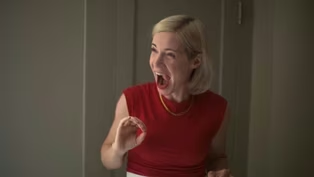
Clip: S3 Ep1 | 4m 9s | Lucy finds out more about the eccentric diplomat Benjamin Franklin. (4m 9s)
Video has Closed Captions
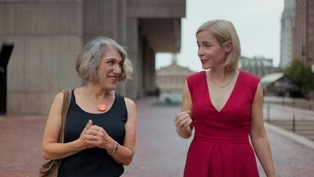
Clip: S3 Ep1 | 3m 15s | Lucy meets Prof Serena Zabin in Boston to learn more about the Boston Massacre. (3m 15s)
Providing Support for PBS.org
Learn Moreabout PBS online sponsorship












Support for PBS provided by: